Enzymes in Skincare: How Enzyme Exfoliants Gently Renew Your Skin
When most people think of exfoliation, they think of acids or facial scrubs. Yet nature has developed another remarkably elegant way to encourage healthy skin renewal: enzymes.
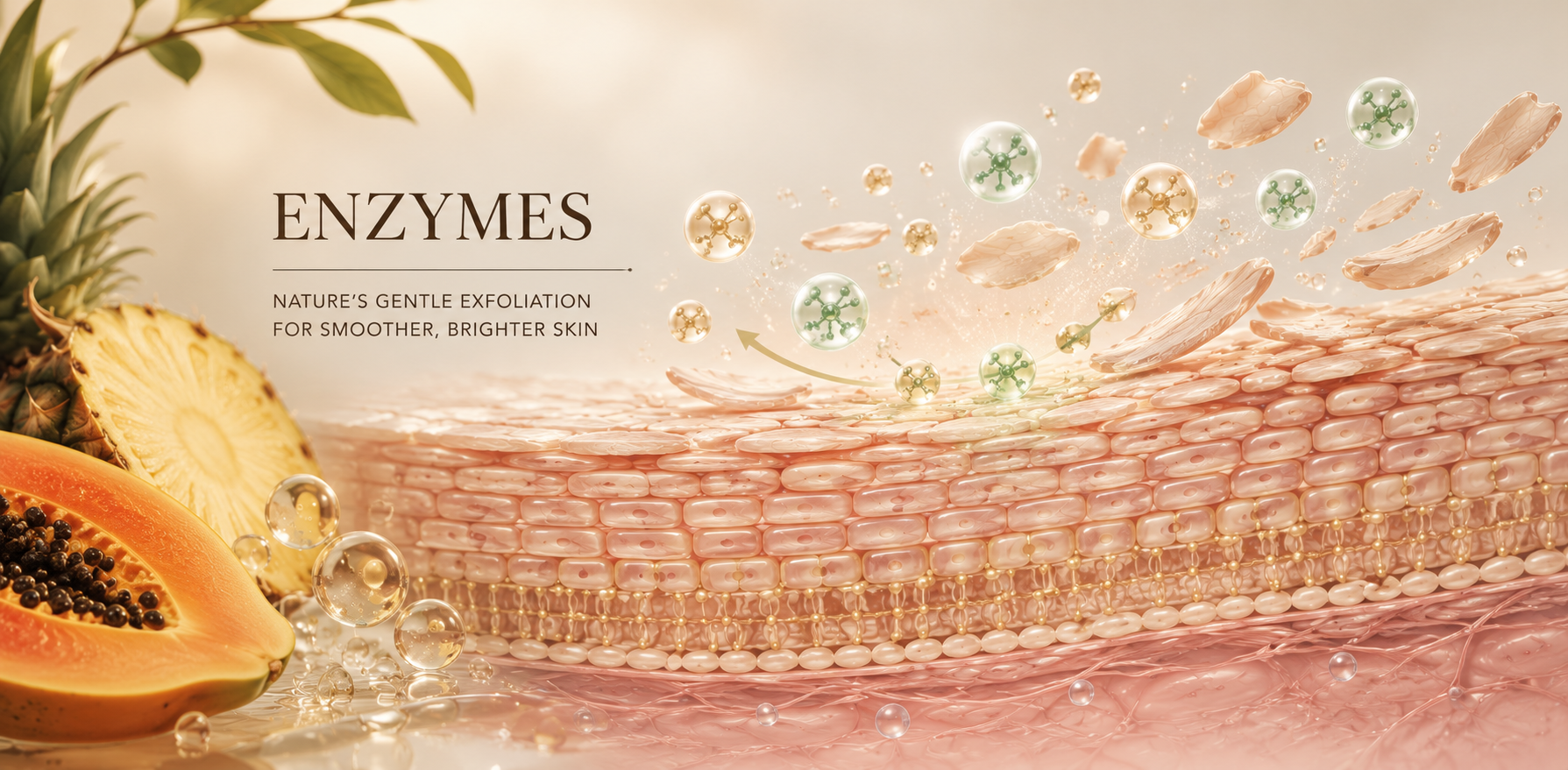
Found naturally in fruits and produced through fermentation, enzymes work differently from acids. Rather than dissolving the bonds between skin cells, they selectively break down the protein found in older, dead surface cells, allowing them to be removed more easily. The result is smoother, brighter-looking skin with a gentle approach that many sensitive skin types appreciate.

Full Lesson
What Are Enzymes?
Enzymes are specialised proteins that speed up natural biological reactions. Every living organism relies on enzymes - from digesting food to healing wounds and producing energy.
In skincare, certain enzymes can help remove the outermost layer of accumulated dead skin cells, encouraging healthier skin renewal without aggressively affecting the surrounding healthy tissue.
Unlike chemical exfoliating acids, which influence the bonds holding skin cells together, enzymes primarily act on proteins found in dead surface cells.
This makes enzyme exfoliation a unique and often gentler approach to achieving smoother, more radiant skin.
Where Do Skincare Enzymes Come From?
Many skincare enzymes are derived from plants or produced through fermentation.
Common examples include:
- Papain from papaya
- Bromelain from pineapple
- Pumpkin enzymes
- Fermented fruit enzymes
- Lactobacillus ferments
Each works slightly differently, but they all share a similar goal: supporting natural skin renewal by helping remove accumulated dead surface cells.

How Do Enzymes Work?
Healthy skin continually renews itself.
New cells form deep within the epidermis before slowly moving towards the surface. Eventually they become flattened, lose their water content and naturally shed.
Sometimes this process slows.
Age, environmental exposure, dehydration and seasonal changes can all contribute to dead skin cells remaining attached for longer than usual.
When this happens, skin may appear:
- Dull
- Rough
- Uneven
- Less reflective
- More prone to congestion
Enzyme exfoliants help by breaking down keratin - the structural protein found within dead surface cells.
Once these proteins are gently digested, the old cells release more easily during cleansing.
Importantly, enzymes work primarily where dead protein is already present, making them naturally selective.
This selective action is one reason enzyme exfoliation is often considered gentler than stronger resurfacing treatments.
Enzymes vs AHAs
Although both improve skin texture, they work differently.
AHAs (Alpha Hydroxy Acids)
- Loosen the bonds between skin cells
- Can penetrate slightly deeper into the upper epidermis
- Often provide faster resurfacing
Enzymes
- Break down proteins within dead surface cells
- Work mainly on the outermost skin layer
- Tend to be gentler and less irritating
Neither approach is inherently better.
The ideal choice depends on your skin type, goals and barrier health.
💡 Joanne's Insight
One of the most common mistakes I see is assuming stronger exfoliation always produces better skin. In reality, healthy skin responds best to consistency, not intensity. Enzyme exfoliation is often enough to restore brightness while allowing the skin barrier to remain comfortable and balanced.
Why Gentle Exfoliation Matters
The outer layer of your skin does much more than simply make your complexion look smooth.
It forms part of your skin barrier—the protective shield that keeps moisture in while helping defend against environmental stress.
Over-exfoliation can disturb this barrier.
When that happens, skin may become:
- Tight
- Sensitive
- Dry
- Red
- Less comfortable
Gentle exfoliation supports natural renewal while respecting this protective barrier.
For many people, this balance leads to healthier-looking skin over time than frequent aggressive treatments.

Who Benefits Most from Enzyme Exfoliation?
Almost every skin type can benefit from occasional exfoliation.
Enzymes may be especially suitable for:
Sensitive Skin
Because enzyme exfoliation is generally gentler than stronger acid treatments, many people with sensitive skin tolerate it well.
Dry Skin
Removing accumulated dead cells can help moisturisers absorb more evenly while improving skin smoothness.
Dull Skin
When excess surface cells are removed, light reflects more evenly across the skin, creating a fresher appearance.
Mature Skin
Natural cell turnover slows with age.
Gentle exfoliation may help support a smoother, brighter complexion without placing unnecessary stress on the skin barrier.
Beginners
If you're new to exfoliation, enzyme products often provide an excellent introduction before progressing to stronger chemical exfoliants if needed.
Can Enzymes Be Used with Other Exfoliants?
Yes—but thoughtfully.
Many modern skincare routines combine enzymes with ingredients such as AHAs or PHAs, although not always on the same day.
Alternating different forms of exfoliation often allows the skin to benefit from multiple mechanisms while reducing the likelihood of irritation.
The key is listening to your skin rather than following the most intensive routine.
❌ Myth vs ✅ Reality
Myth: Enzyme exfoliants are too gentle to make any difference.
Reality: Gentle does not mean ineffective. Regular enzyme exfoliation can noticeably improve skin smoothness and radiance while placing less stress on the skin barrier than more aggressive approaches.
🧠 Did You Know?
Your skin naturally sheds around 30,000–40,000 dead skin cells every minute. Exfoliation doesn't create this process—it simply helps support the skin's normal renewal when older cells linger on the surface.
Why This Matters
Healthy skin isn't about removing as many layers as possible.
It's about supporting the remarkable renewal process your skin already performs every day.
When dead cells accumulate, even excellent skincare products may struggle to interact evenly with the skin's surface.
Gentle exfoliation can help:
- Improve skin texture
- Increase surface smoothness
- Enhance natural radiance
- Allow hydrating products to spread more evenly
- Support a more refined complexion
Most importantly, enzyme exfoliation reminds us that effective skincare doesn't always need to be aggressive.
Sometimes working with the skin—not against it—produces the healthiest long-term results.
✨ Why It Matters
Healthy skin is constantly renewing itself. Enzyme exfoliation simply helps remove the cells that are ready to leave, allowing fresher skin beneath to become visible while respecting the skin barrier that keeps your complexion healthy and comfortable.
👩⚕️ Skin Therapist Tip
If you're introducing an enzyme exfoliant for the first time, begin with once a week after cleansing. Follow with a hydrating serum and moisturiser, and always wear sunscreen during the day to help protect newly revealed skin.

Which Shanga Products Contain Enzymes?
Several Shanga formulations use enzymes or fermented enzyme technologies to support gentle skin renewal:
- Reveal Face Polish – contains Lactobacillus/Papaya Fruit Ferment Extract, combining gentle physical polishing with papaya-derived enzymatic exfoliation.
- Reveal Tonic – contains Papain (papaya enzyme) alongside botanical extracts to support gentle overnight renewal.
- Dual Action Peel – features Lactobacillus/Punica Granatum (Pomegranate) Fruit Ferment Extract, combining fermentation technology with lactic acid for multi-pathway exfoliation.
- Renew Eye Cream – includes Carica Papaya (Papaya) Fruit Extract, providing additional botanical enzyme activity within a barrier-supportive eye treatment.
These ingredients are selected to complement the skin's natural renewal process while maintaining comfort and barrier integrity.
Conclusion
Enzymes demonstrate that effective skincare doesn't always need to be powerful to be beneficial.
By selectively helping remove dead surface cells, enzyme exfoliants support smoother texture, brighter-looking skin and healthier product absorption while respecting the skin's protective barrier.
For many people, they provide an elegant middle ground between doing nothing and reaching for stronger resurfacing treatments—proving that sometimes the gentlest approach is exactly what healthy skin needs.
Key Takeaways
- Enzymes are natural proteins that help remove dead surface skin cells.
- They work differently from AHAs by breaking down proteins rather than loosening cellular bonds.
- Enzyme exfoliation is generally gentler than many chemical exfoliants.
- Regular gentle exfoliation may improve skin texture and radiance.
- Healthy exfoliation should always support—not compromise—the skin barrier.
- Enzyme products are often well suited to sensitive, dry and beginner skincare routines.
- Consistency is usually more beneficial than aggressive exfoliation.
Continue Your Learning
Enzyme exfoliation helps reveal fresher skin on the surface, but protecting those newly revealed cells from environmental damage is equally important. In the next Shanga Academy lesson, we'll explore Resveratrol, a powerful plant-derived antioxidant that helps defend skin against oxidative stress while supporting long-term skin health. Next lesson