How Skin Changes With Age
Your skin is always changing. Understanding those changes is the first step towards caring for it well.
Your skin is never still.
From childhood through to later life, it is constantly renewing, adapting and responding to both your body and the world around you. Some changes happen quickly, while others unfold so gradually that they are almost impossible to notice from one year to the next.
Understanding these natural changes helps explain why your skin's needs evolve over time. Healthy skincare isn't about trying to stop ageing—it is about supporting your skin as it continues to do its remarkable work through every stage of life.

Full Lesson
Skin Is Designed to Evolve
One of the most remarkable things about skin is that it never stops changing.
Every day, millions of skin cells are replaced. Collagen is produced. Natural oils are secreted. Tiny areas of damage are repaired. Your immune system quietly protects you while your skin barrier works continuously to keep moisture in and unwanted irritants out.
During childhood and early adulthood, these systems work with incredible efficiency.
Over time, however, they gradually begin to slow.
This is a completely normal part of human biology.
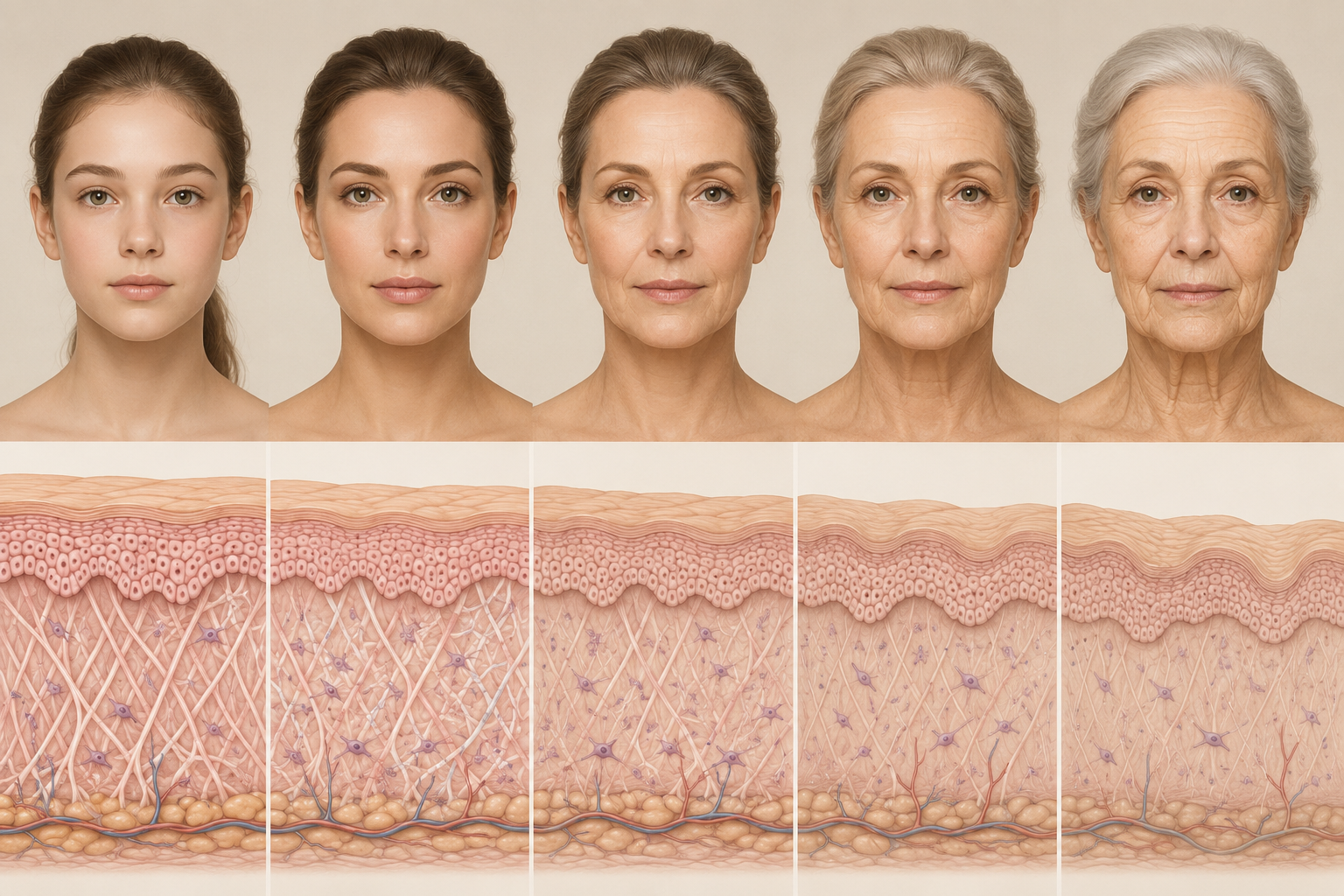
Rather than thinking of ageing as something that suddenly happens, it is more helpful to think of it as thousands of tiny changes occurring over many years.
By the time you notice a fine line or a slight loss of firmness, those biological changes may have been quietly developing beneath the surface for decades.
🧠 Did You Know?
Your skin renews itself throughout your entire life. Even in older adulthood, new skin cells continue to form—the process simply becomes more gradual.

Renewal Naturally Slows
The outer layer of your skin is continually renewing itself.
New cells are formed deep within the epidermis before slowly travelling towards the surface. Eventually they become part of your skin barrier before naturally shedding.
This process is known as cell turnover.
In younger skin, renewal happens relatively quickly.
As we age, this journey gradually takes longer.
The result is subtle but noticeable.
Skin may appear:
- less radiant
- slightly rougher
- slower to recover after irritation
- more likely to hold onto uneven pigmentation after inflammation
This slower renewal is simply one example of the skin adapting over time.
It doesn't mean your skin has stopped working.
It simply means it is working at a different pace.
💡 Joanne's Insight
One of the biggest misconceptions I hear is that mature skin has "given up". In reality, healthy skin continues renewing itself throughout life. My goal has never been to make skin behave like it did at twenty—it's to help it function as well as it can today.
The Skin's Support Structure Evolves
Beneath the surface lies the dermis, where much of your skin's strength and resilience is created.
Specialised cells called fibroblasts produce two important proteins:
Collagen, which gives skin strength and structure.
Elastin, which allows skin to stretch and return to its original shape.
Together they create the supportive framework that helps skin feel firm, smooth and resilient.
As the years pass, fibroblasts become less active.
Collagen production gradually slows.
Existing collagen is broken down more quickly than it is replaced.
Elastin also becomes less organised and has a limited ability to regenerate once damaged.
These changes contribute to many of the features we naturally associate with mature skin, including:
- fine lines
- reduced firmness
- softer facial contours
- decreased elasticity
Importantly, these changes happen gradually.
They are part of healthy ageing - not signs that your skin is failing.

❌ Myth vs ✅ Reality
Myth: Wrinkles appear because your skin suddenly stops producing collagen.
Reality: Collagen production slows gradually over many years. Wrinkles develop as a result of many small biological changes rather than one single event.
The Skin Barrier Needs More Support
The skin barrier is your body's frontline defence.
It helps prevent water loss while protecting against everyday environmental stress.
As skin matures, the barrier often becomes more delicate.
Natural lipids become less abundant.
Moisture escapes more easily.
Recovery from irritation may take longer.
This helps explain why mature skin often feels:
- drier
- tighter after cleansing
- more sensitive to active ingredients
- less comfortable during seasonal changes
Supporting the barrier becomes increasingly important with age.
Rather than using stronger products, mature skin often benefits from consistent hydration, gentle cleansing and ingredients that reinforce the skin's natural protective systems.

Your Environment Changes Alongside You
Not every change in skin is determined by age alone.
Your skin also reflects years of interaction with the environment.
Scientists describe this as extrinsic ageing.
Some of the biggest influences include:
Sunlight
Ultraviolet radiation is the single greatest external contributor to premature skin ageing, affecting collagen, elastin and pigmentation over time.
Lifestyle
Sleep, nutrition, smoking, exercise and stress all influence how well the skin functions throughout life.
Daily Skincare
Consistent skincare cannot stop ageing, but it can help support healthy skin by protecting the barrier, maintaining hydration and reducing unnecessary environmental stress.
Small habits repeated over many years often have a greater influence than dramatic treatments performed only occasionally.
👩⚕️ Skin Therapist Tip
If your skincare routine hasn't changed in years, your skin may have changed more than you realise. Reassessing your routine every few years helps ensure it continues supporting your skin's current needs rather than those it had a decade ago.
Why This Matters
Ageing is often spoken about as something to fight.
Skin biology tells a different story.
Your skin continues adapting throughout your entire life.
It continues protecting you.
It continues healing.
It continues renewing itself.
Understanding these changes allows you to make better skincare decisions—not because you're trying to turn back the clock, but because you're learning how to support the remarkable organ you already have.
✨ Why It Matters
Healthy skin doesn't have an age.
Whether you're twenty-five or seventy-five, the goal remains the same: support your skin's natural ability to protect, renew and adapt every single day.

Conclusion
Ageing is one of the most natural things your skin will ever do.
Over time, collagen gradually declines, elastin becomes less resilient, cell renewal slows and the skin barrier requires more support.
Yet throughout every stage of life, your skin continues performing an extraordinary number of functions every single day.
The role of skincare isn't to stop this process.
It's to work with your skin's biology, supporting its natural ability to protect, renew and thrive—today, tomorrow and for many years to come.
Key Takeaways
- Skin is constantly changing throughout life.
- Cell turnover naturally slows with age.
- Collagen and elastin gradually become less abundant.
- The skin barrier often becomes more delicate over time.
- Sun exposure is the largest external contributor to premature skin ageing.
- Consistent hydration, barrier care and sun protection support healthy skin at every age.
- Healthy ageing is about maintaining skin function, not chasing perfection.
Continue Your Learning
As your skin changes with age, one of the most important daily habits becomes protecting it from the environment.

In the next lesson, Morning vs Evening Skincare, you'll discover why your skin has different priorities during the day and overnight, and how adjusting your routine to match its natural rhythms can help support healthy skin for years to come. Go to next lesson