How to Build a Skincare Routine
After learning how skin works, the next question is naturally, "Where do I start?"
A good skincare routine isn't about using the most products. It's about choosing the right products, using them in the right order and being consistent over time. Every step has a purpose, from cleansing away the day to protecting your skin from the Australian sun.
In this lesson, you'll bring together everything you've learned so far and discover how to build a routine that supports healthy skin—without unnecessary complexity.

Full Lesson
Your Routine Should Work With Your Skin—Not Against It
The skincare industry can make routines seem overwhelming. Ten-step regimens, endless ingredient combinations and constantly changing trends often leave people wondering whether they're doing enough.
In reality, healthy skin doesn't require dozens of products.
It needs consistency.
Each product should have a clear purpose, supporting the remarkable biology already taking place within your skin every day.
Everything you've learned throughout this course comes together here:
- Your skin barrier prefers gentle care.
- Your microbiome thrives when it's left balanced.
- Your skin naturally repairs itself overnight.
- Hydration and moisturisation are different but equally important.
- Morning and evening routines each have unique roles.
Rather than adding products because they're popular, build your routine around what your skin actually needs.
💡 Joanne's Insight
After treating thousands of skins over the years, one pattern appears again and again.
The people who achieve the healthiest-looking skin usually aren't the ones using the most products.
They're the ones who consistently use a simple routine that suits their skin.
Consistency almost always outperforms complexity.
Understanding the Four Foundations of Every Routine
Almost every effective skincare routine can be simplified into four essential goals.
1. Cleanse
Throughout the day, your skin collects sunscreen, excess oil, pollution, sweat and environmental particles.
Cleansing removes these without stripping away the protective barrier.
In the morning, cleansing prepares the skin for protection.
In the evening, it removes the day's build-up so your treatment products can be applied to clean skin.
2. Treat
Treatment products contain ingredients designed to support specific skin concerns.
Examples include:
- Vitamin C for antioxidant protection
- Niacinamide for barrier support and oil balance
- Retinoids for overnight skin renewal
- Chemical exfoliants used occasionally to encourage surface renewal
Not everyone needs every treatment.
Choose products that match your own skin goals.
3. Moisturise
A moisturiser supports the skin barrier by helping reduce water loss.
It also improves comfort and helps maintain healthy skin function.
Remember what you learned earlier:
Hydration adds water.
Moisturisation helps keep that water inside the skin.
Both matter.
4. Protect
During the day, sunscreen becomes the final and arguably most important step.
While skincare supports healthy skin, daily UV protection helps reduce one of the biggest external contributors to premature skin ageing.
Protection is what preserves the benefits of everything else you do.

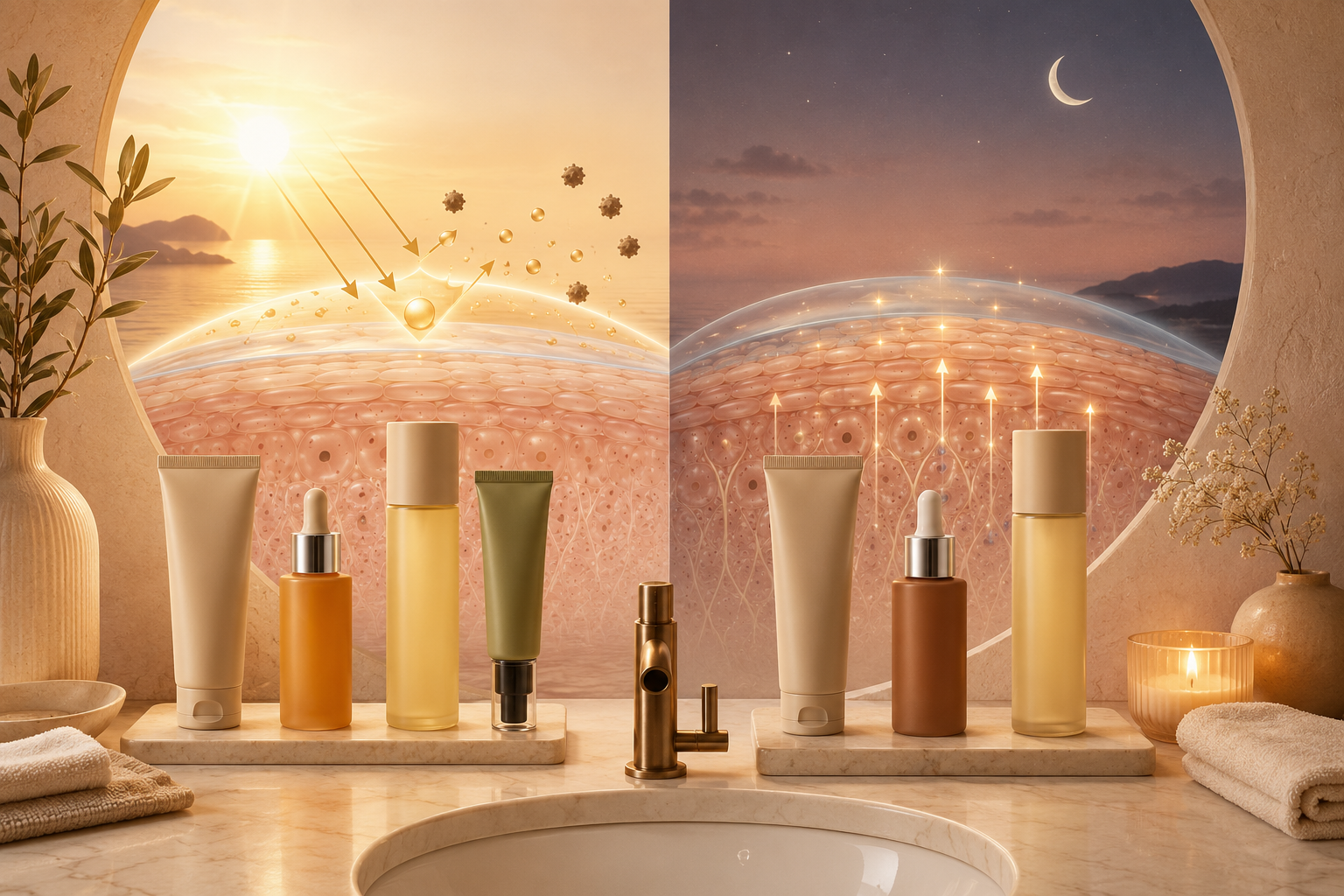
Morning and Evening Have Different Jobs
One of the biggest improvements you can make to your routine is understanding that skin has different priorities during the day and at night.
Morning: Prepare and Protect
Your morning routine focuses on helping skin face the environment.
A typical routine includes:
- Gentle cleanser
- Hydrating mist (optional)
- Antioxidant or targeted serum
- Moisturiser
- Sunscreen
Think of the morning as preparing your skin for the day ahead.
Evening: Cleanse and Support Renewal
At night, your skin shifts its attention towards maintenance and renewal.
Your evening routine may include:
- Cleanser
- Gentle exfoliating tonic (on appropriate nights)
- Treatment serum
- Moisturiser
Some active ingredients, such as retinoids, are usually best reserved for evening use because they support overnight skin renewal.
🧠 Did You Know?
Your skin doesn't "sleep," but many of its natural repair and renewal processes become more active overnight. That's one reason evening skincare often focuses on treatment rather than protection.
Less Can Often Be More
It's tempting to believe that adding more products will produce better results.
However, every product introduces additional ingredients to the skin.
When too many active ingredients are layered together, they may increase irritation without providing additional benefit.
A thoughtful routine allows your skin to respond gradually.
For most people, a complete routine only needs:
- One cleanser
- One moisturiser
- One sunscreen
- One or two targeted treatment products
Everything else is optional.
❌ Myth vs ✅ Reality
Myth: A longer skincare routine is always more effective.
Reality: Healthy skin responds best to routines that are appropriate for its needs. Using more products doesn't necessarily improve results and may sometimes overwhelm the skin.
Building Your Routine Step by Step
If you're starting from scratch, resist the urge to buy everything at once.
Instead, introduce products gradually.
Step One
Start with:
- Cleanser
- Moisturiser
- Sunscreen
These three products form the foundation of healthy skincare.
Step Two
Once your skin feels comfortable and consistent, add one treatment product.
Choose based on your primary goal, such as:
- Brightening
- Hydration
- Barrier support
- Congestion
- Healthy ageing
Step Three
Introduce additional products only if they solve a specific problem.
Ask yourself:
"What purpose does this product actually serve?"
If you can't answer that question, you may not need it.

Adapting Your Routine Over Time
Healthy skin isn't static.
Your routine shouldn't be either.
Many factors influence what your skin needs:
- Age
- Seasons
- Climate
- Hormonal changes
- Stress
- Lifestyle
- Travel
Your skin may need more hydration during winter.
You may prefer lighter moisturisers during humid summers.
You might reduce exfoliation if your barrier feels sensitive.
Listening to your skin is more valuable than following trends.
👩⚕️ Skin Therapist Tip
Whenever you introduce a new active ingredient, use it only two or three times each week initially.
Give your skin time to adapt before increasing frequency.
Slow, consistent progress is usually more comfortable than making several changes at once.
Why Consistency Matters More Than Perfection
One of the most common reasons people feel disappointed with skincare is constantly changing routines.
Healthy skin responds gradually.
Every time you replace products after only a short period, you interrupt your ability to see how your skin is adapting.
A routine followed consistently for several weeks often teaches you far more than switching products every few days.
Good skincare is less about chasing the newest ingredient and more about supporting your skin over months and years.
✨ Why It Matters
Building a skincare routine isn't about following rules.
It's about creating simple daily habits that support your skin's natural biology.
When every product has a purpose, your routine becomes easier to maintain, easier to understand and more enjoyable to follow.
The best routine is one you can comfortably continue every day.

Conclusion
A skincare routine doesn't need to be complicated to be effective.
When you understand what each step does, you're able to make thoughtful decisions instead of following marketing trends.
Start with the essentials.
Introduce new products slowly.
Protect your skin every day.
Stay consistent.
Your skin is constantly working to protect and renew itself. A well-designed routine simply supports those natural processes.
Key Takeaways
- Healthy skincare routines focus on purpose rather than product quantity.
- Every routine is built around cleansing, treating, moisturising and protecting.
- Morning routines prepare skin for the day, while evening routines support overnight renewal.
- Introduce new products gradually instead of changing everything at once.
- Consistency usually delivers better long-term outcomes than complicated routines.
- Your skincare routine should evolve as your skin changes over time.
- Sunscreen remains one of the most important daily skincare habits.
Continue Your Learning
Now that you've built your skincare routine, the next question is often, "When will I start seeing results?"

In the next lesson, How Long Skincare Takes to Work, you'll learn how skin renewal influences visible changes, why different ingredients work at different speeds, and how to set realistic expectations that help you stay consistent with your routine. Go to next lesson