Olive Oil for Skin: An Ancient Botanical with Modern Benefits
For centuries, olive oil has been valued for nourishing both the body and the skin. Today, modern skincare science has helped explain why this traditional botanical remains relevant. Rich in healthy fatty acids, vitamin E and naturally occurring antioxidants, olive oil helps soften the skin and support its protective barrier. While it isn't the ideal choice for every skin type, carefully formulated products can make excellent use of olive-derived ingredients. Understanding how olive oil works allows you to choose products that suit your skin rather than simply following trends.

Introduction to Olive Oil in Skincare
Olive oil is one of the oldest skincare ingredients known to humanity.
Long before laboratories existed, people around the Mediterranean used olive oil to cleanse, soften and protect their skin. While today's formulations are considerably more sophisticated, many of the reasons olive oil became so popular remain scientifically valid.
Modern cosmetic science has identified the compounds responsible for many of olive oil's beneficial properties. Rather than simply coating the skin, these natural lipids help reinforce the skin's outer protective barrier and reduce moisture loss.
Like many botanical oils, however, olive oil isn't a universal solution.
Its rich composition makes it excellent for some skin types while being less suitable for others.
Understanding that difference is the key to using it wisely.
What Is Olive Oil?
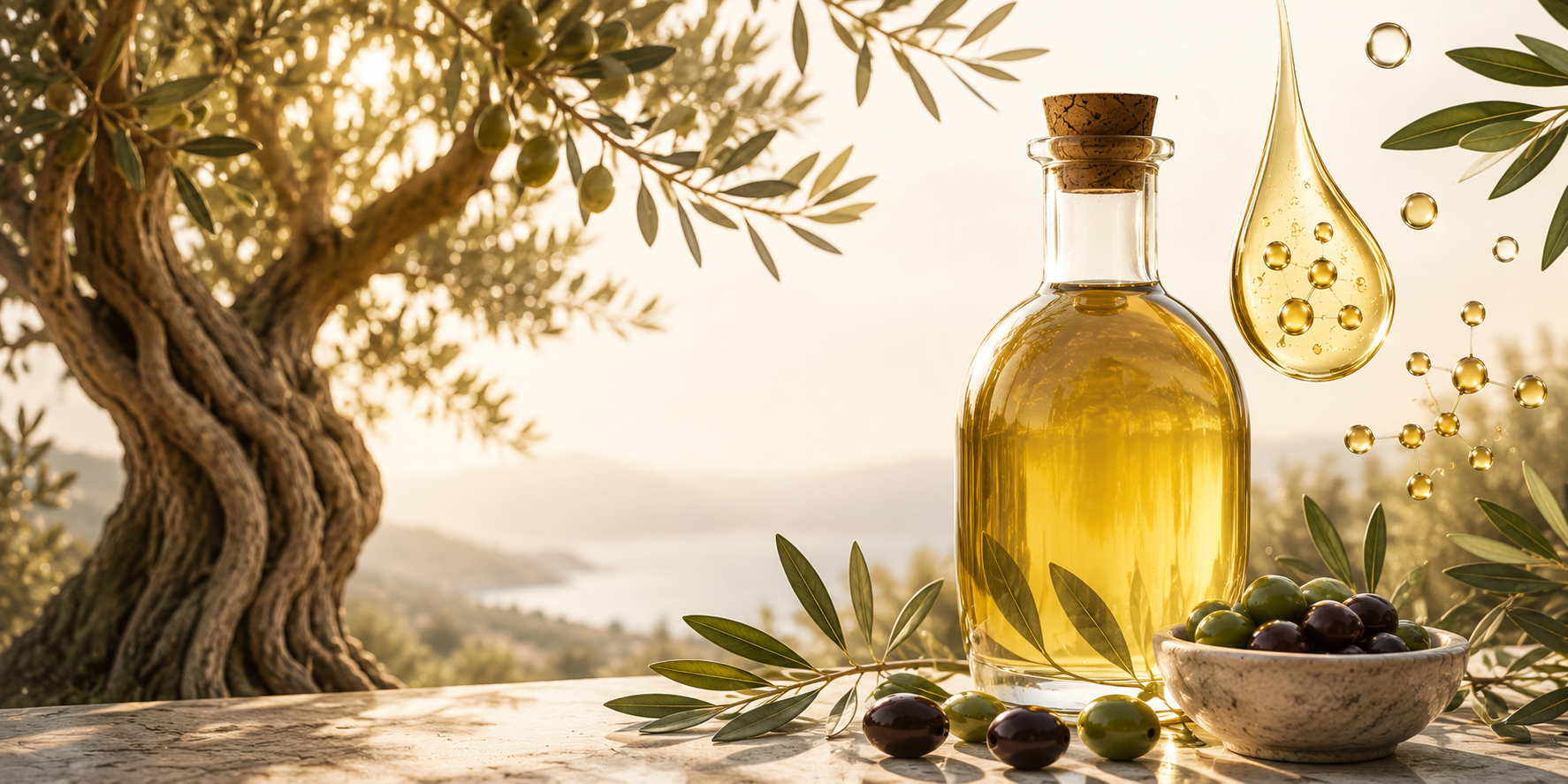
Olive oil is extracted from the fruit of the olive tree (Olea europaea).
Extra virgin olive oil is produced through mechanical pressing without chemical refining, helping preserve many of its naturally occurring nutrients.
For skincare, olive oil contains several components that make it valuable:
- Oleic acid (Omega-9)
- Smaller amounts of linoleic acid
- Vitamin E (tocopherols)
- Plant sterols
- Squalene
- Polyphenol antioxidants
Each contributes differently to skin health.
Oleic acid is particularly important because it acts as an emollient—helping soften the skin and reduce roughness.
Vitamin E and polyphenols provide antioxidant support by helping neutralise free radicals generated through everyday environmental exposure.
Squalene (not to be confused with squalane) is naturally found in both olives and human sebum, making olive oil particularly compatible with the skin's own protective oils.

How Olive Oil Supports the Skin Barrier
The outermost layer of your skin—the skin barrier—is built from skin cells surrounded by lipids.
These lipids work much like mortar between bricks, helping prevent excessive water loss while protecting against external irritants.
Olive oil contributes primarily by supplying additional lipids that reinforce this barrier.
When applied within a balanced skincare formulation, olive oil can:
- soften dry skin
- reduce moisture loss
- improve skin comfort
- support barrier resilience
- leave skin feeling smoother
It does this by creating a light protective film that slows transepidermal water loss (TEWL).
Importantly, olive oil works best as part of a complete formulation rather than on its own.
Modern moisturisers carefully combine olive-derived ingredients with humectants, ceramides, peptides and other barrier-supporting ingredients to provide more balanced hydration.
Olive Oil and Antioxidants
Olive oil also contains naturally occurring antioxidant compounds.
Throughout the day, UV exposure and pollution generate unstable molecules known as free radicals.
These molecules can gradually affect healthy skin structures over time.
Antioxidants don't completely stop this process, but they help neutralise many of these unstable molecules before they contribute to oxidative stress.
This is one reason olive oil continues to appear in premium skincare formulations centuries after its first use.
💡 Joanne's Insight
During treatments I've often found that people with dry or mature skin assume they simply need "more moisturiser." In reality, many benefit from replenishing lipids as well as water. Ingredients like olive oil help provide those nourishing lipids, allowing moisturisers to feel richer and more comforting without relying solely on heavy occlusive ingredients.
Is Olive Oil Suitable for Every Skin Type?
Not always.
Olive oil is naturally rich in oleic acid.
While this makes it wonderfully nourishing for dry skin, it may feel too rich for some people with oily or congestion-prone skin.
That doesn't mean olive oil is "bad."
It simply means that different fatty acid profiles suit different skin needs.
Generally speaking:
Dry Skin
Olive oil can provide valuable nourishment and softness.
Mature Skin
Its emollient properties can improve skin comfort while supporting the barrier.
Sensitive Skin
Many people tolerate well-formulated olive-derived ingredients well, although every individual is different.
Oily or Congested Skin
Some people prefer lighter botanical oils that contain more linoleic acid, such as grapeseed or watermelon seed oil.
The overall formulation matters far more than any single ingredient.
A thoughtfully balanced moisturiser containing olive-derived ingredients often performs very differently from applying pure olive oil directly onto the skin.

❌ Myth vs ✅ Reality
Myth: Olive oil clogs everyone's pores.
Reality: Olive oil is richer than many botanical oils, but whether a product suits your skin depends on the complete formulation and your individual skin type—not a single ingredient alone.
🧠 Did You Know?
Olive trees can live for hundreds of years, and some Mediterranean olive trees are believed to be well over 1,000 years old.
Why This Matters
Many people choose skincare based on a single "hero ingredient."
In reality, healthy skin responds to balanced formulations.
Olive oil demonstrates this perfectly.
On its own, it offers nourishing fatty acids and antioxidants.
Combined with ingredients like ceramides, humectants, peptides and vitamins, it becomes part of a much broader strategy for supporting healthy skin.
Understanding this helps you look beyond marketing claims and appreciate why formulators carefully combine ingredients rather than relying on just one botanical.
✨ Why It Matters
Healthy skin needs both water and lipids.
Humectants attract moisture, while nourishing oils help keep that moisture where it's needed.
Olive oil contributes valuable skin-friendly lipids that support comfort, softness and barrier function, particularly for drier skin types.
Which Shanga Products Contain Olive-Derived Ingredients?
Several Shanga formulations include olive-derived ingredients chosen for their skin-conditioning properties rather than simply adding olive oil itself.
Radiance Elixir
Contains Olea Europaea (Olive) Fruit Oil, alongside watermelon seed oil, argan oil, avocado oil, jojoba oil, grapeseed oil and several other botanical oils to nourish the skin and support barrier function.
De-Light SPF
Contains Hydrogenated Olive Oil Unsaponifiables and Hydrogenated Ethylhexyl Olivate. These olive-derived ingredients help improve skin feel, support the barrier and contribute to a comfortable finish while the sunscreen filters provide UV protection.
Restore Cream
Contains Cetearyl Olivate and Sorbitan Olivate, naturally derived emulsifiers from olive oil that help create a luxurious texture while supporting the skin barrier.
These examples highlight an important principle of modern formulation: olive-derived ingredients are often used in different forms depending on the function required—whether nourishing the skin, stabilising a cream or enhancing texture.
👩⚕️ Skin Therapist Tip
If your skin feels tight after cleansing, applying a moisturiser containing nourishing botanical oils while your skin is still slightly damp can help seal in hydration more effectively than waiting until the skin is completely dry.

Conclusion
Olive oil has earned its reputation over thousands of years, and modern science continues to explain why.
Its blend of healthy fatty acids, vitamin E and naturally occurring antioxidants helps support the skin's protective barrier while improving softness and comfort.
Like every skincare ingredient, however, olive oil works best when used thoughtfully.
The right formulation, the right concentration and the right combination of ingredients determine how effectively it performs.
Rather than viewing olive oil as a miracle ingredient, it's more accurate to see it as one valuable member of a much larger family of botanical oils—each with its own unique strengths.
Key Takeaways
- Olive oil is naturally rich in oleic acid, vitamin E and antioxidant compounds.
- It helps support the skin barrier by reducing moisture loss.
- Dry and mature skin often benefit most from olive-derived ingredients.
- The overall formulation matters more than any single ingredient.
- Olive-derived ingredients appear in several Shanga formulations, including Radiance Elixir, Restore Cream and De-Light SPF.
- Different botanical oils offer different fatty acid profiles to suit different skin needs.
Continue Your Learning
Olive oil is just one member of a remarkably diverse family of botanical oils. In the next Academy lesson, we'll explore Cucumber Oil and Other Lesser-Known Botanical Oils, discovering how unique fatty acid profiles and plant compounds contribute to modern skincare formulations.