Pigmentation Explained: Understanding Uneven Skin Tone
Many people notice areas of skin that appear darker than the surrounding complexion. These changes may develop gradually over time or become more noticeable after sun exposure, inflammation or skin injury. While pigmentation is often viewed as simply a cosmetic concern, it is actually the result of the skin's remarkably sophisticated natural defence system.
Understanding how pigment is produced—and why it sometimes becomes uneven—is the first step towards making informed skincare decisions. In this lesson, we'll explore how skin colour is created, why pigmentation develops, and the biological processes that influence a more even-looking complexion.

At a Glance
To understand why pigmentation develops, we first need to understand the remarkable role melanin plays in protecting healthy skin.
What is pigmentation?
Pigmentation refers to the natural colouring of the skin created by a pigment called melanin.
What causes uneven pigmentation?
Uneven pigmentation develops when some areas of skin produce or retain more melanin than surrounding skin.
Is pigmentation harmful?
Most pigmentation changes are harmless, although some new or changing pigmented spots should always be assessed by a medical professional.
Can pigmentation improve?
Many forms of pigmentation may gradually improve with appropriate sun protection, consistent skincare and, where appropriate, professional treatment. Results vary depending on the underlying cause.
Why Does Our Skin Have Pigment?
Before understanding pigmentation concerns, it helps to understand why our skin contains pigment in the first place.
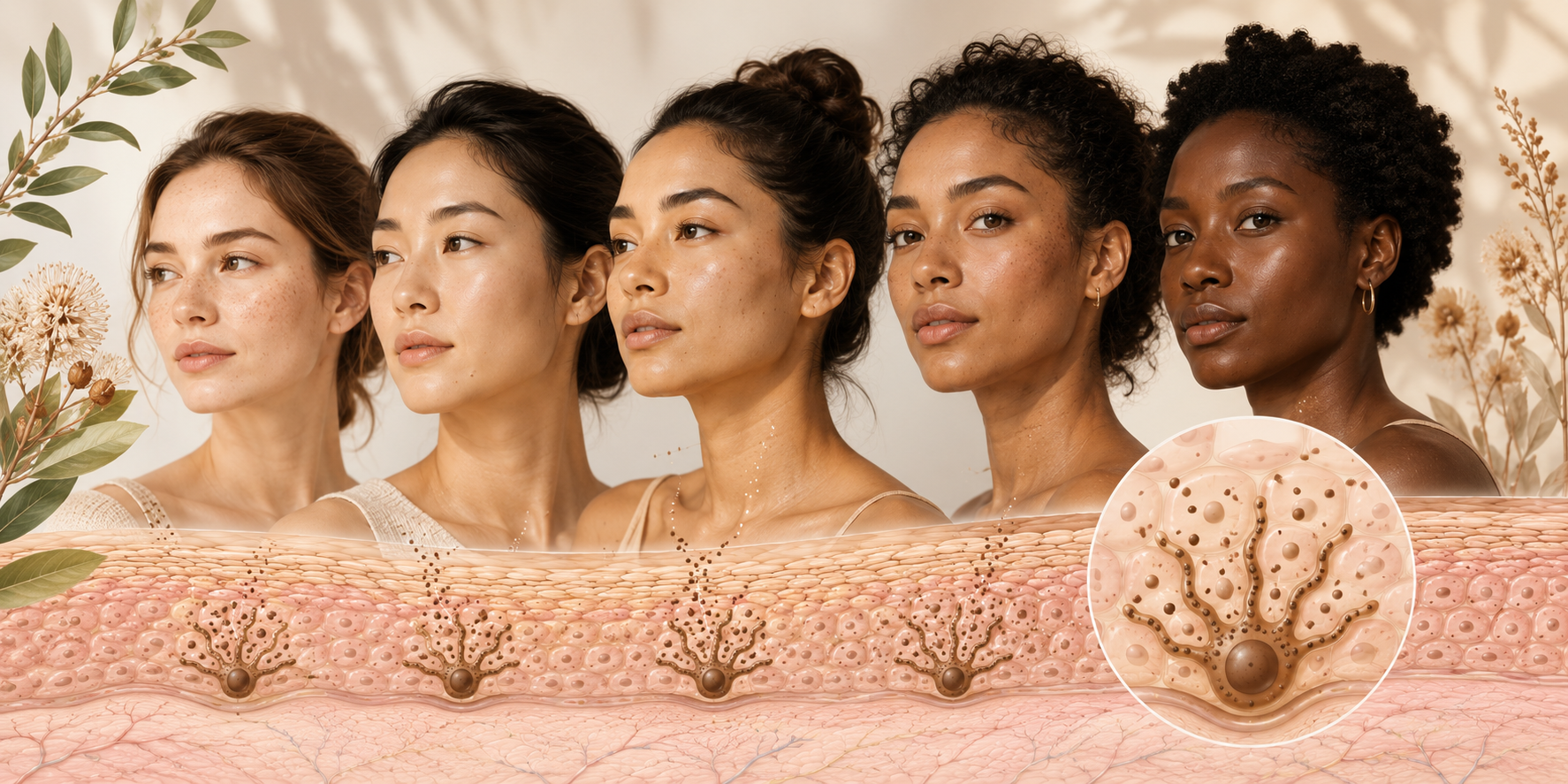
Melanin is a natural pigment produced inside specialised cells called melanocytes. These cells are located within the deepest layer of the epidermis (the outer layer of skin).
Rather than colouring only individual cells, melanocytes produce tiny packets of pigment called melanosomes, which are transferred into surrounding skin cells called keratinocytes.
As these skin cells gradually move towards the skin surface during normal skin renewal, they carry melanin with them. This process gives our skin its natural colour while also helping protect deeper tissues from ultraviolet (UV) radiation.
Inside each skin cell, melanin often gathers above the nucleus—the part of the cell that contains its DNA. Scientists sometimes describe this arrangement as a "melanin umbrella" because it helps absorb and scatter some ultraviolet (UV) radiation before it reaches the cell's genetic material. While it cannot block all UV damage, this natural shield plays an important role in protecting healthy skin.

Melanin is therefore much more than skin colour—it is one of the skin's most important protective mechanisms.

What Is Melanin?
Although people often refer to pigmentation as "extra pigment," melanin is actually present in everyone's skin.
The amount, type and distribution of melanin create the beautiful diversity of human skin tones around the world.
Melanin performs several important functions.
It helps:
- absorb some ultraviolet radiation
- reduce DNA damage from sunlight
- help protect deeper skin structures
- contribute to natural skin colour
- support the skin's protective response to environmental stress.
Your skin is continually balancing pigment production to help maintain this natural protection.
The Two Main Types of Melanin
Human skin contains two primary forms of melanin.
Eumelanin
Eumelanin appears brown to black and provides the greatest protection against ultraviolet radiation.
People with darker complexions naturally produce higher levels of eumelanin.
Pheomelanin
Pheomelanin appears yellow to reddish in colour.
People with lighter skin and red hair generally have relatively higher amounts of pheomelanin.
Pheomelanin provides less UV protection than eumelanin, which partly explains why lighter skin tends to burn more easily.
In reality, most people produce a mixture of both forms, with genetics determining the overall balance.

Why Does Uneven Pigmentation Develop?
Under normal circumstances, melanocytes produce relatively even amounts of melanin across the skin.
Sometimes, however, these cells become more active in certain areas than others.
When this happens, additional melanin is transferred into surrounding skin cells, making that area appear darker than neighbouring skin.
This is known as hyperpigmentation, meaning an increase in visible pigment.
Importantly, pigmentation does not usually mean there are more melanocytes. Instead, existing melanocytes are simply producing more melanin than usual.
This distinction helps explain why pigmentation often develops after various skin stresses rather than being a separate skin disease itself.

What Triggers Increased Melanin Production?
Melanocytes respond to a wide variety of biological signals.
These signals tell the skin when additional protection may be required.
Some of the most common triggers include:
- ultraviolet (UV) exposure
- visible light in some people
- inflammation
- skin injury
- hormonal influences
- ageing
- certain medications
- genetics.
Although these triggers differ, many activate similar pigment-producing pathways inside melanocytes.
Later lessons will explore each of these factors in greater depth.
Pigmentation Is Part of the Skin's Defence System
One of the most important ideas to understand is that pigmentation is usually a protective response rather than a mistake.
When melanocytes detect damage or stress, producing more melanin is one way the skin attempts to reduce further injury.
For example, after spending time in the sun, your skin may darken as it produces additional melanin to help protect itself from future ultraviolet exposure.
Similarly, after inflammation such as acne, eczema or irritation, pigment-producing cells may remain activated for longer than necessary, leaving temporary areas of darker colour once the original inflammation has settled.
Understanding pigmentation as a protective process helps explain why treatment often requires patience. The skin is gradually returning to its normal pigment balance rather than simply removing unwanted colour.

The Different Types of Pigmentation and What Causes Them
By now, we've seen that pigmentation is usually part of the skin's natural protective response rather than simply "extra pigment." However, not all pigmentation develops in the same way.
Two areas of skin may appear similarly dark, yet the biological processes responsible for them can be quite different. This helps explain why a skincare product or treatment that works well for one person may have little effect for another.
In fact, pigmentation is not a diagnosis but a broad term used to describe areas of skin that appear darker because of increased melanin. The underlying cause can vary significantly from person to person.
Some forms of pigmentation develop gradually after years of sun exposure, while others follow inflammation, hormonal changes or the natural ageing process. Pigment may also be located at different depths within the skin, which influences both its appearance and how readily it responds to treatment.
Understanding the cause of pigmentation is one of the most important steps in choosing the most appropriate management approach. It also helps set realistic expectations, as different types of pigmentation often require different strategies and improve at different rates.
Sun-Induced Pigmentation
One of the most common forms of uneven pigmentation develops gradually after repeated ultraviolet (UV) exposure. Over many years, melanocytes are repeatedly stimulated to produce melanin as part of the skin's protective response. Eventually, some areas begin producing more pigment than others, creating visible areas of darker colour.
This can appear in several ways, including:
- freckles that become darker after sun exposure
- solar lentigines (sun spots)
- uneven patches of pigmentation
- mottled areas of colour on frequently sun-exposed skin.
The face, chest, shoulders and backs of the hands are among the most commonly affected areas because they receive regular sun exposure throughout life.
Although both freckles and sun spots become more noticeable with UV exposure, they develop differently. Freckles are largely determined by genetics. They often appear during childhood, darken during periods of increased sun exposure and fade when UV exposure decreases.
Solar lentigines, commonly called sun spots or age spots, usually develop later in life after many years of cumulative sun exposure. Unlike freckles, they tend to persist throughout the year and gradually increase in number over time.
Unlike a suntan, which typically fades as the skin naturally renews itself, long-term sun-induced pigmentation may persist because repeated UV exposure continues to stimulate melanin production.

Post-Inflammatory Hyperpigmentation (PIH)
Not all pigmentation is caused by sunlight.
Many people notice darker marks developing after the skin has experienced inflammation.
This is known as post-inflammatory hyperpigmentation, often shortened to PIH.
The inflammation itself may come from:
- acne
- eczema
- dermatitis
- insect bites
- burns
- cosmetic procedures
- skin irritation
- picking or scratching.
During the healing process, inflammatory signals stimulate nearby melanocytes to produce additional melanin.
Although the inflammation eventually settles, the extra pigment may remain visible for weeks or even months while normal skin renewal gradually removes it.
PIH is particularly common in medium and deeper skin tones because melanocytes are often more responsive to inflammatory signals.
Importantly, PIH is not permanent scarring. It represents excess pigment left behind after healing rather than permanent damage to the skin's structure.

Melasma
Melasma is a common form of pigmentation that usually appears as larger, symmetrical patches of brown or grey-brown colour.
It most commonly affects the:
- cheeks
- forehead
- upper lip
- chin.
Unlike sun spots, melasma often develops because several factors interact at the same time.
These may include:
- hormonal influences
- sunlight
- visible light
- genetics
- heat exposure in some individuals.
Melasma is particularly common during pregnancy or while using certain hormonal medications, although it can affect anyone.
One of the reasons melasma can be challenging to manage is that melanocytes remain highly responsive to even relatively small amounts of stimulation.
For this reason, careful sun protection usually forms an important part of long-term management.

|
Type |
Common Cause |
Typical Appearance |
|
PIH |
Inflammation |
Brown marks after acne |
|
Melasma |
Hormones + UV |
Symmetrical patches |
|
Solar Lentigines |
UV exposure |
Well-defined sun spots |
|
Freckles |
Genetics |
Darken with sun |
Pigmentation Can Affect Every Skin Tone
Pigmentation is sometimes thought of as a concern affecting only certain skin tones, but this is not the case.
People of every complexion can experience uneven pigmentation.
However, the appearance and persistence of pigmentation often differ between individuals.
Those with naturally darker skin usually have more active melanocytes and greater baseline melanin production. While this provides increased natural UV protection, it can also make pigment changes more noticeable or longer lasting after inflammation or injury.
Lighter skin tones may develop pigment changes differently, often alongside redness or sun-related changes.
Neither response is better or worse—they simply reflect differences in normal skin biology.

Pigmentation May Involve Different Skin Layers
Another important difference between pigmentation types is where the excess pigment is located.
Some pigmentation sits mainly within the epidermis, the outer layer of the skin.
This type often appears:
- light brown
- tan
- more sharply defined.
Other pigmentation extends deeper into the dermis, where pigment becomes trapped following inflammation or injury.
Deeper pigmentation may appear:
- blue-grey
- slate coloured
- more diffuse
- slower to improve.
Some conditions involve both layers simultaneously.
The deeper the pigment lies, the longer it generally takes to fade because normal skin renewal affects the epidermis much more rapidly than the dermis.

Why Correct Identification Matters
Because different biological pathways produce different forms of pigmentation, there is no single skincare ingredient or treatment that works equally well for everyone.
Some pigmentation responds primarily to reducing ongoing UV exposure.
Others improve by controlling inflammation.
Hormonal pigmentation may require a broader management approach, while deeper pigmentation often improves more gradually than surface changes.
This is why professional assessment can be particularly valuable when pigmentation is widespread, rapidly changing or difficult to identify.
Understanding the cause allows treatment to focus on supporting the underlying biology rather than simply attempting to lighten the skin.
Why Treating Pigmentation Is Different from Treating the Pigment Itself
After understanding why pigmentation develops, the next step is understanding how it can be managed.
Many people naturally assume that successful treatment simply removes existing pigment. In reality, most effective skincare works by influencing the biological processes that continue creating uneven pigmentation.
Depending on the cause, treatment may aim to:
- reduce ongoing stimulation of melanocytes
- slow excessive melanin production
- encourage normal skin renewal
- reduce inflammation that triggers pigment formation
- protect the skin from further UV-induced pigment production.
Rather than "bleaching" the skin, modern evidence-informed skincare aims to support the skin's natural pigment regulation while helping maintain an even-looking complexion.
Sun Protection Is the Foundation of Every Pigmentation Routine
No skincare ingredient can consistently improve pigmentation if the skin continues receiving frequent ultraviolet exposure.
Every episode of UV exposure has the potential to stimulate melanocytes, encouraging additional melanin production—even before a visible sunburn develops.
This is why dermatologists and skin therapists consistently describe daily sun protection as the single most important step in managing pigmentation.
Broad-spectrum sunscreen helps by:
- reducing UV-triggered melanin production
- helping prevent existing pigmentation from becoming darker
- lowering the chance of new pigmentation developing
- protecting the results achieved through skincare or professional treatments.
For many people, sunscreen is not simply preventative—it is an active part of pigmentation management.

How Brightening Ingredients Support More Even Skin Tone
There is no single "best" ingredient for pigmentation because different pathways contribute to pigment formation.
Instead, many skincare routines combine ingredients that support different aspects of pigment regulation.
Vitamin C
Vitamin C is one of the most widely studied brightening ingredients.
It helps by:
- supporting antioxidant protection
- reducing oxidative stress created by UV exposure
- helping support a brighter-looking complexion
- assisting collagen production while protecting against environmental damage.
Niacinamide
Niacinamide works differently.
Rather than primarily reducing pigment production, research suggests it may help reduce the transfer of melanosomes from melanocytes into surrounding skin cells.
This can gradually improve the appearance of uneven pigmentation while also supporting the skin barrier.
Vitamin A (Retinoids)
Retinoids increase normal skin renewal.
As pigmented skin cells are naturally shed and replaced, areas of superficial pigmentation may gradually become less noticeable.
Retinoids may also help regulate several biological pathways involved in pigmentation, making them valuable long-term ingredients when appropriate for the individual.
Other Brightening Ingredients
Additional ingredients commonly included in pigmentation routines include:
- Azelaic acid
- Tranexamic acid (topical)
- Licorice root extract
- Alpha arbutin
- Cysteamine
- Kojic acid (where appropriate)
- Peptides that support pigment regulation.
Each works through slightly different biological pathways, which is why combination approaches are often recommended.

Skin Renewal Gradually Removes Surface Pigment
One reason pigmentation improves slowly is that the skin naturally renews itself over time.
As new skin cells form within the epidermis, older pigmented cells gradually move towards the surface before being shed.
This continual renewal means superficial pigmentation often fades gradually when:
- ongoing pigment production has reduced
- sun protection is maintained
- inflammation is controlled
- appropriate skincare supports healthy cell turnover.
Deeper pigmentation improves more slowly because pigment located within the dermis is largely unaffected by normal epidermal renewal.

Professional Treatments May Be Appropriate for Some Types of Pigmentation
Although many people achieve improvement with consistent skincare, some pigmentation benefits from professional assessment and treatment.
Depending on the diagnosis, a clinician may recommend:
- prescription topical medications
- chemical peels
- laser treatment
- intense pulsed light (IPL)
- skin needleing
- combination therapy.
These treatments work in different ways depending on the type of pigmentation being treated.
Not every pigmentation concern is suitable for every treatment.
For example, some lasers that work well for sun-induced pigmentation may worsen melasma if used inappropriately.
This highlights the importance of accurate diagnosis before beginning treatment.
Consistency Matters More Than Speed
Pigmentation often develops gradually over months or years.
It is therefore unrealistic to expect dramatic improvement within a few weeks.
Instead, successful management usually involves:
- daily sun protection
- consistent skincare
- avoiding unnecessary irritation
- reducing inflammation
- allowing normal skin renewal to occur.
Small improvements accumulate over time.
Patience often produces better long-term outcomes than frequently changing products or using overly aggressive treatments.

Setting Realistic Expectations
One of the most important aspects of pigmentation management is understanding that improvement depends on the type of pigmentation involved.
Some superficial pigmentation responds relatively well to consistent skincare.
Other forms, particularly melasma or deeper dermal pigmentation, may improve more slowly and often require long-term maintenance.
The goal is not necessarily to remove every trace of pigment, but to support healthier skin while gradually encouraging a more even-looking complexion.
This evidence-informed approach helps reduce frustration and supports realistic expectations throughout treatment.
Why It Matters
Understanding pigmentation is about much more than achieving a more even-looking complexion.
Throughout this lesson, we've seen that pigmentation is usually the skin's natural protective response rather than a flaw that needs to be "fixed." Melanin helps defend our cells against environmental stress, particularly ultraviolet (UV) radiation, and the same biological processes that protect us can sometimes leave areas of uneven pigmentation behind.
Recognising this changes the way we approach treatment.
Rather than trying to remove pigment as quickly as possible, evidence-informed skincare focuses on supporting healthy skin function, reducing unnecessary pigment stimulation and allowing the skin's natural renewal processes to work over time.
This perspective also encourages realistic expectations. Pigmentation rarely develops overnight, and meaningful improvement usually occurs gradually through consistent daily care rather than aggressive treatments.
Ultimately, understanding the biology behind pigmentation allows you to make more informed decisions, avoid common misconceptions and build a skincare routine that supports healthier-looking skin for the long term.

Skin Therapist Tip
One of the most common mistakes people make when treating pigmentation is trying to improve it too quickly.
Layering multiple active ingredients, over-exfoliating or changing products every few weeks can increase irritation and inflammation. Ironically, this may stimulate further pigmentation in some individuals, particularly those with medium to deeper skin tones.
Instead, build a simple routine around three priorities:
- Daily broad-spectrum sunscreen.
- Consistent use of evidence-informed brightening ingredients suited to your skin.
- Protecting the skin barrier by avoiding unnecessary irritation.
When the skin remains calm and protected, it is better able to regulate pigment production naturally.

Joanne's Insight
Many clients arrive at the salon believing pigmentation simply needs to be "lightened."
After assessing their skin, we often discover the priority is actually protecting the skin barrier, calming ongoing inflammation or improving daily sun protection.
Once these foundations are in place, the skin is often better able to regulate pigment naturally.
One of the most rewarding parts of treating pigmentation is seeing clients become less focused on chasing quick results and more confident in building healthy habits that support their skin over time.
Healthy skin rarely changes overnight, but consistent daily care often produces meaningful improvements that continue well into the future.
Continue Your Learning
Pigmentation is only one part of the skin's complex biology.
To better understand why uneven pigmentation develops—and how skincare supports healthy skin—you may also enjoy these lessons:
- Understanding Your Skin
- The Skin Barrier Explained
- Inflammation and skin health
- Cell Turnover
- Vitamin C in Skincare
- Niacinamide Explained
- Vitamin A (Retinoids)
- Daily Sun Protection
Together, these lessons build a deeper understanding of how the skin protects itself and how evidence-informed skincare supports healthy skin function.
Key Takeaways
- Pigmentation is created by melanin, the skin's natural protective pigment.
- Uneven pigmentation usually develops because melanocytes produce more melanin in certain areas rather than because there are more pigment cells.
- Sunlight, inflammation, hormones, genetics and ageing can all influence pigment production.
- Different types of pigmentation have different underlying causes and may respond differently to treatment.
- Daily sun protection is the foundation of every pigmentation routine.
- Brightening ingredients support pigment regulation through different biological pathways rather than simply "bleaching" the skin.
- Superficial pigmentation usually improves gradually through normal skin renewal, while deeper pigmentation often takes longer.
- Consistency, patience and protecting the skin barrier usually produce better long-term outcomes than aggressive skincare.

Conclusion
Pigmentation is one of the skin's most visible responses to the world around us.
Whether triggered by sunlight, inflammation, hormones or ageing, these changes reflect the remarkable ability of the skin to protect itself rather than a simple cosmetic flaw.
While there is no universal solution for every type of pigmentation, understanding the biology behind melanin production allows skincare decisions to become more informed and more realistic.
Daily sun protection, consistent skincare, patience and healthy skin barrier function remain the foundations of long-term management.
Most importantly, healthy skin is not defined by perfect colour or complete uniformity. Skin naturally changes throughout life, and every complexion tells a unique biological story.
By working with the skin—rather than against it—you can support healthier, stronger and more even-looking skin over time.