
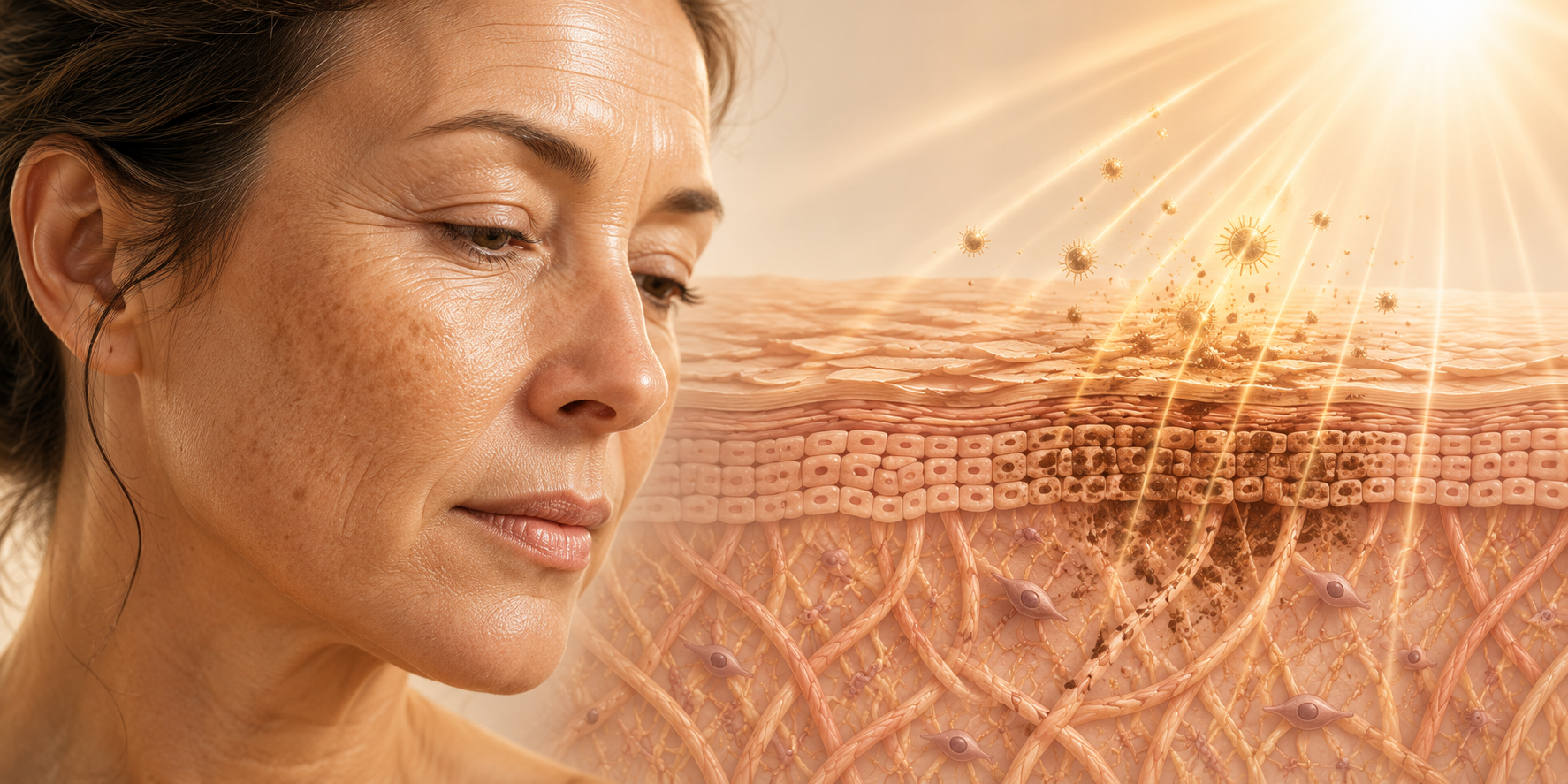
Sun Damage (Photoageing): Understanding How UV Exposure Changes Your Skin
Many people associate sun damage with sunburn, but much of the skin ageing caused by sunlight develops slowly and silently over decades. Long before wrinkles, pigmentation or rough texture become visible, ultraviolet (UV) radiation is already affecting collagen, elastin and the skin's natural repair systems.
This process is known as photoageing—premature skin ageing caused by repeated exposure to ultraviolet radiation. Unlike intrinsic ageing, which occurs naturally with time, photoageing is influenced by lifestyle and environmental exposure, making it one of the most preventable causes of visible skin ageing.
Understanding how photoageing develops helps explain why daily sun protection remains one of the most effective long-term investments you can make in your skin's health.
What Is Photoageing?
Photoageing refers to the gradual structural and functional changes that occur in the skin after repeated exposure to ultraviolet radiation from the sun.
Unlike a single episode of sunburn, photoageing develops slowly. Every time skin is exposed to UV radiation, tiny amounts of biological damage occur. While the skin repairs much of this damage, the repair is never completely perfect. Over many years, these small changes accumulate.
Eventually they contribute to:
- fine lines and wrinkles
- uneven pigmentation
- loss of firmness
- rougher texture
- enlarged blood vessels
- dullness
- reduced elasticity.
Photoageing affects people of every skin tone, although the visible signs can differ depending on natural pigmentation.

Intrinsic Ageing vs Photoageing
Everyone's skin naturally changes with age.
As we grow older, collagen production gradually slows, skin renewal becomes less efficient, and elastin slowly loses some of its flexibility. These natural changes are called intrinsic ageing.
Photoageing is different.
Instead of simply reflecting the passing of time, it results from repeated environmental exposure—particularly ultraviolet radiation. UV exposure accelerates many of the same biological processes that occur during natural ageing, but at a much faster rate.
This is why two people of the same age may have very different-looking skin depending on their lifetime sun exposure.
One may have relatively smooth skin with minimal pigmentation, while another may develop deeper wrinkles, uneven pigmentation and rougher texture despite being the same age.

Understanding Ultraviolet Radiation
Sunlight contains several types of ultraviolet radiation, but two play the greatest role in skin ageing.
UVA
UVA penetrates deeply into the dermis, where collagen and elastin provide the skin's structural support.
Although UVA causes relatively little immediate redness, it is responsible for much of the cumulative damage associated with photoageing. Because UVA penetrates window glass, exposure also occurs while driving or sitting near windows.
Repeated UVA exposure contributes to:
- collagen breakdown
- elastin damage
- oxidative stress
- reduced skin firmness
- wrinkle formation.
UVB
UVB primarily affects the outer layers of the skin.
It is the main cause of sunburn and plays an important role in DNA damage that increases the risk of skin cancer.
UVB also stimulates melanin production, contributing to tanning and many forms of pigmentation.
Together, UVA and UVB contribute to the gradual biological changes associated with photoageing.

Why Sun Damage Builds Slowly
One day in the sun rarely produces visible wrinkles.
Instead, photoageing develops because UV exposure is cumulative.
Each exposure creates small amounts of oxidative stress, collagen damage and DNA injury. The body repairs much of this damage, but over time the repair becomes less complete.
Think of it like repeatedly bending a paperclip.
One bend causes very little change.
Thousands of bends eventually weaken the metal.
The same principle applies to skin.
Years of repeated UV exposure gradually weaken its structural support until visible signs of ageing begin appearing.

Why Understanding Photoageing Matters
Photoageing is not simply about appearance.
The same biological processes that create wrinkles and pigmentation also affect the skin's overall health and resilience.
Understanding these changes provides the foundation for learning:
- how UV damages collagen
- why pigmentation develops
- why antioxidants matter
- how sunscreen helps protect the skin
- why consistent skincare supports healthier-looking skin over time.
How UV Radiation Damages the Skin
We explored what photoageing is, why it develops gradually over time, and how repeated exposure to UVA and UVB contributes to premature skin ageing.
Now we'll look beneath the surface to understand what actually happens inside the skin after ultraviolet radiation is absorbed.
Although UV rays are invisible, they trigger a cascade of biological events involving oxidative stress, inflammation, collagen breakdown and changes to the skin's natural repair systems. These microscopic changes occur long before wrinkles or pigmentation become visible.
Understanding these processes helps explain why daily sun protection and evidence-informed skincare can make such a meaningful difference over the long term.
What Happens When UV Reaches the Skin?
The skin has evolved remarkable defence mechanisms to cope with sunlight, but these protective systems have limits.
When ultraviolet radiation reaches the skin, some energy is absorbed by molecules within skin cells. This absorbed energy can directly damage DNA or generate reactive oxygen species (ROS), a group of highly reactive molecules commonly referred to as free radicals.
Free radicals are highly reactive because they contain unpaired electrons. In an attempt to become stable, they react with nearby proteins, lipids and DNA.
Most of the time, the skin's own antioxidant systems neutralise many of these molecules before significant damage occurs.
However, when UV exposure is frequent or prolonged, free radical production can exceed the skin's natural defences.
This imbalance is known as oxidative stress.
Oxidative stress plays a central role in many of the biological changes associated with photoageing.

Free Radicals and Skin Ageing
Free radicals are produced naturally during normal metabolism, but ultraviolet radiation greatly increases their production.
These unstable molecules can affect many important structures within the skin, including:
- collagen fibres
- elastin fibres
- fibroblasts
- cell membranes
- DNA
- the extracellular matrix.
The more frequently oxidative stress occurs, the greater the demand placed on the skin's repair systems.
Fortunately, the body produces its own antioxidant enzymes to help neutralise free radicals. We also obtain antioxidant nutrients from foods and some topical skincare ingredients.
While antioxidants cannot prevent every effect of UV exposure, they help reduce some of the oxidative stress generated by sunlight.
DNA Damage and the Skin's Repair Systems
Ultraviolet radiation can also damage DNA inside skin cells.
UVB is particularly effective at causing direct DNA injury within the epidermis, while UVA contributes more indirectly through oxidative stress.
Fortunately, skin cells possess sophisticated DNA repair mechanisms that constantly identify and repair damaged genetic material.
Most of this repair occurs successfully.
However, repeated UV exposure places increasing demands on these repair systems. As we age, repair efficiency also gradually declines.
Over many years, small amounts of unrepaired damage can accumulate, contributing to both photoageing and an increased risk of certain skin cancers.
Fortunately, these repair systems work remarkably well for much of our lives, highlighting why reducing ongoing UV exposure is so important.
This is one reason dermatologists consistently emphasise sun protection throughout life rather than only after visible ageing appears.

Inflammation: The Skin's Emergency Response
Ultraviolet radiation doesn't simply affect individual cells.
It also activates the skin's immune and inflammatory systems.
Inflammation is an essential part of healing. After UV exposure, specialised signalling molecules help coordinate repair, remove damaged cells and restore normal function.
Short-term inflammation is beneficial.
The problem arises when UV exposure is repeated frequently over many years.
Persistent low-level inflammation can gradually contribute to tissue damage and accelerate many of the biological changes associated with photoageing.
Researchers sometimes refer to this process as chronic low-grade inflammation or "inflammageing."
Rather than being caused by one severe sunburn, inflammageing develops through countless small inflammatory events accumulated over decades.
Mitochondria and Cellular Energy
Every skin cell relies on tiny structures called mitochondria to produce the energy needed for normal function and repair.
Ultraviolet radiation can affect mitochondrial function by increasing oxidative stress within the cell.
When mitochondria become less efficient, cells may have fewer resources available for:
- repair
- collagen production
- healthy cell renewal
- maintaining normal skin function.
Although this change is gradual, reduced cellular energy is thought to contribute to the slower repair capacity seen in photoaged skin.

The Skin Can Repair—But Not Forever
One of the most remarkable features of skin is its ability to repair itself.
Every day, damaged cells are replaced, collagen is continually remodelled, and countless microscopic injuries heal without us ever noticing.
However, repair is never perfect.
Each episode of UV exposure leaves behind tiny biological changes. Individually they are almost insignificant, but over many years they gradually accumulate.
Eventually these accumulated changes begin to alter the skin's structure and function, creating the visible signs we recognise as photoageing.
This explains why the effects of sun exposure often become more noticeable later in life, even though much of the underlying damage occurred years or even decades earlier.
How UV Radiation Leads to Wrinkles — And Where Skincare Can Help
We've explored how ultraviolet radiation generates reactive oxygen species (ROS), damages DNA and activates inflammation within the skin. These microscopic changes occur long before wrinkles become visible.
But how do these cellular events actually lead to fine lines, loss of firmness and the visible signs of photoageing?
The answer lies in a delicate balance between collagen breakdown and collagen production.
Healthy skin is constantly remodelling itself. Old collagen fibres are naturally removed while fibroblasts produce new collagen to maintain the skin's structural support. In youthful skin, these two processes remain in balance.
Repeated UV exposure gradually disrupts this balance.
From UV Exposure to Wrinkles
One of the most important biological pathways in photoageing can be summarised as:
Ultraviolet Radiation
↓
Reactive Oxygen Species (ROS)
↓
Matrix Metalloproteinase (MMP) Activation
↓
Collagen Breakdown
↓
Reduced New Collagen Production
↓
Loss of Structural Support
↓
Fine Lines and Wrinkles
Rather than causing immediate visible ageing, this process develops slowly through thousands of small episodes of UV exposure accumulated over many years.
Matrix Metalloproteinases: The Enzymes That Break Down Collagen
Matrix metalloproteinases, or MMPs, are a family of enzymes naturally produced by the body.
Under normal circumstances, they play an essential role in tissue repair and healthy collagen remodelling. They help remove older or damaged collagen so that new collagen can replace it.
Problems arise when ultraviolet radiation repeatedly activates these enzymes.
Excessive MMP activity causes collagen to be broken down faster than it can be replaced. Over time, the organised collagen network within the dermis becomes increasingly fragmented and weakened.
This imbalance is considered one of the central biological mechanisms responsible for photoageing.

Fibroblasts Can No Longer Keep Up
Collagen breakdown is only part of the story.
Fibroblasts—the specialised cells responsible for producing collagen, elastin and much of the skin's extracellular matrix—are also affected by repeated UV exposure.
Over time, photoaged fibroblasts become less efficient at producing new collagen.
The result is a double effect:
- more collagen is being broken down
- less new collagen is being produced.
This gradual shift weakens the skin's structural framework and contributes to the visible signs of ageing.
Healthy Collagen Becomes Fragmented
Healthy collagen fibres form an organised network that provides strength and support throughout the dermis.
Repeated activation of collagen-degrading enzymes gradually fragments these fibres into shorter, weaker segments.
Instead of forming a dense supportive scaffold, fragmented collagen creates a disorganised structure that provides less support for the skin above it.
As this process continues, the skin gradually loses firmness, elasticity and resilience.
Eventually, fine lines deepen into more noticeable wrinkles.

Evidence-Informed Skincare Supports Healthier Skin
While no skincare product can completely reverse decades of accumulated UV exposure, several evidence-informed ingredients help support healthier skin function by acting at different points in the photoageing pathway.
Sunscreen Helps Reduce Ongoing UV Injury
Broad-spectrum sunscreen helps reduce the amount of ultraviolet radiation reaching the skin.
By reducing UV exposure, sunscreen helps decrease the biological events that trigger photoageing, including oxidative stress, collagen degradation and DNA damage.
Rather than repairing existing damage, sunscreen helps prevent additional damage from occurring.
For this reason, it remains the single most effective topical product for reducing premature skin ageing.
Vitamin A Supports Skin Renewal and Collagen Production
Vitamin A derivatives, including retinoids, are among the most extensively studied ingredients for photoaged skin.
Retinoids support normal epidermal renewal while also encouraging fibroblast activity and healthy collagen production within the dermis.
With consistent use, they may help improve the appearance of fine lines, skin texture and overall firmness.
Because retinoids can increase skin sensitivity during the early stages of treatment, they are best introduced gradually and always paired with daily sunscreen.

Vitamin C Supports Collagen Formation
Vitamin C supports healthy skin in several ways, but two of its most important roles in photoageing are:
Firstly, it acts as an antioxidant, helping neutralise some of the reactive oxygen species generated by UV exposure.
Secondly, it is an essential cofactor for the enzymes responsible for producing healthy collagen.
Without sufficient vitamin C, collagen cannot be formed normally.
This makes vitamin C one of the few skincare ingredients that both supports the skin's antioxidant defences and contributes directly to healthy collagen synthesis.
Niacinamide Supports Barrier Function and Cellular Resilience
Niacinamide supports the skin in a different way.
Rather than directly stimulating collagen production, it helps strengthen the skin barrier, improve hydration and support overall cellular resilience.
Healthy barrier function helps skin better tolerate environmental stress while maintaining normal function over time.
Its excellent tolerability also makes niacinamide suitable for many skin types.
Healthy Skin Is Built Through Daily Habits
Photoageing develops gradually, and healthier skin is built gradually too.
No single product can prevent every aspect of skin ageing.
Instead, the greatest long-term benefit comes from combining daily sun protection with evidence-informed skincare that supports the skin's natural repair and renewal processes.
Together, sunscreen, vitamin A, vitamin C and niacinamide each contribute in different ways.
Rather than replacing one another, they work as complementary parts of a comprehensive skincare routine.

Why Understanding Photoageing Matters
Photoageing is often thought of as something that happens later in life, when wrinkles or pigmentation become more noticeable. In reality, the biological changes begin much earlier.
Every day our skin is exposed to sunlight, it responds by repairing microscopic damage. For many years these repair systems work remarkably well, but repeated ultraviolet (UV) exposure gradually places increasing demands on the skin. Over time, collagen becomes fragmented, fibroblasts become less efficient, and the skin's ability to repair itself slowly declines.
The encouraging news is that photoageing is not an all-or-nothing process.
While we cannot completely erase decades of accumulated sun exposure, we can significantly influence what happens next. Daily sun protection, together with evidence-informed skincare, helps reduce ongoing UV damage while supporting the skin's natural repair, renewal and barrier function.
Healthy skin is not created by one miracle ingredient or one perfect treatment. It is built through thousands of small, consistent decisions made over many years.

Joanne's Insight
One of the biggest misconceptions I hear is that skincare only becomes important once wrinkles appear.
In reality, the skin is changing long before we can see those changes on the surface. That's why prevention is always more powerful than correction.
Rather than chasing quick fixes, I encourage people to think about supporting their skin the way we support the rest of our health. Wearing sunscreen, using evidence-informed ingredients and caring for the skin consistently allows it to function at its best for longer.
Healthy skin isn't about looking younger than your age—it's about helping your skin remain healthy, resilient and functioning well throughout every stage of life.
Key Takeaways
- Photoageing is premature skin ageing caused primarily by repeated ultraviolet (UV) exposure.
- UVA contributes largely to collagen breakdown and long-term structural damage, while UVB is the main cause of sunburn and direct DNA damage.
- UV exposure increases oxidative stress, activates collagen-degrading enzymes (MMPs) and gradually reduces the skin's ability to repair itself.
- Healthy collagen depends on a balance between collagen breakdown and new collagen production. Photoageing disrupts this balance over time.
- Daily broad-spectrum sunscreen remains the single most effective topical strategy for reducing further photoageing.
- Vitamin A, vitamin C and niacinamide each support skin health through different biological pathways and work best as complementary ingredients within a consistent routine.
- Meaningful improvements develop gradually through long-term daily habits rather than overnight solutions.
Continue Your Learning
Now that you understand how ultraviolet radiation affects collagen, DNA and the skin's repair systems, you can explore the individual biological processes in greater depth.
Continue with:
- How Oxidative Stress Affects the Skin
- Free Radicals Explained
- Understanding Collagen
- DNA Damage and Skin Repair
- How Vitamin C Supports Healthy Skin
- Understanding Vitamin A (Retinoids)
- Why Daily Sunscreen Matters
Each lesson builds on the previous one, helping you develop a deeper understanding of how healthy skin functions and how evidence-informed skincare can support it over time.
Conclusion
Photoageing reminds us that healthy skin is shaped by the choices we make every day.
Sunlight is an important part of life, but repeated UV exposure gradually influences the skin beneath the surface long before visible ageing appears. Understanding these biological processes allows us to move beyond skincare myths and focus on strategies supported by scientific evidence.
By combining daily sun protection with ingredients that support the skin's natural repair and renewal processes, we help create an environment where the skin can function more effectively over time.
Healthy skin isn't about perfection.
It's about protecting what you have today, supporting your skin's remarkable biology, and building habits that continue to benefit your skin for years to come.