Collagen Explained
Collagen is one of the most talked-about words in skincare, yet it's often misunderstood. While many products promise to "boost collagen," understanding what collagen actually is helps make sense of what skincare can—and cannot—do.
Collagen is the body's most abundant structural protein. Within the skin, it forms an intricate framework that gives the skin strength, firmness and resilience. Throughout life, your skin continuously builds and remodels collagen, but this natural process gradually slows with age and environmental exposure.
Understanding collagen helps you make realistic skincare choices and appreciate why consistency matters more than quick fixes.

What Is Collagen?
If the skin were a beautifully constructed building, collagen would be its internal framework.
Although we see the smooth surface of the skin every day, much of its strength comes from structures hidden beneath the surface.
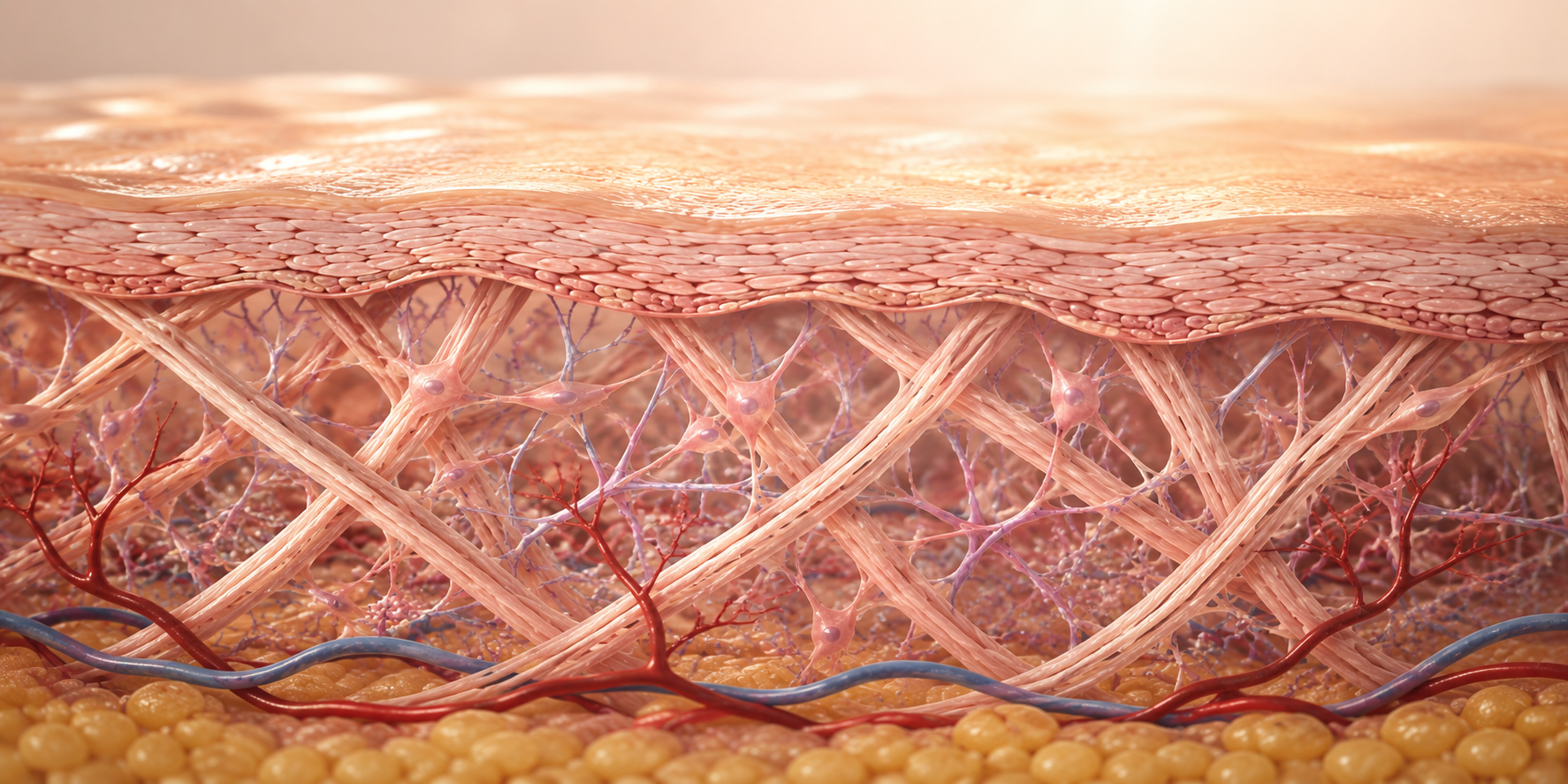
Collagen is a family of proteins found throughout the body, including the skin, bones, tendons and connective tissues. In the skin, collagen forms a dense network within the dermis—the middle layer that sits beneath the epidermis.
Rather than acting as a single sheet, collagen exists as countless fibres woven together into an organised scaffold. This network provides support while allowing the skin to remain flexible enough for everyday movement.
Healthy collagen helps skin feel:
- Firm
- Strong
- Smooth
- Resilient
- Able to recover from everyday stretching and movement
Without collagen, skin would lack much of its natural structure.
🧠 Did You Know?
Around 70–80% of the dry weight of the dermis is made up of collagen, making it the skin's most abundant structural protein.

The Collagen Framework
Think of collagen as the scaffolding inside a building.
The walls may look smooth from the outside, but hidden beams and supports are what allow the structure to stand strong.
Your skin works much the same way.
Collagen fibres are constantly supporting the tissues above them while allowing the skin to bend, smile, stretch and heal.
Unlike concrete, however, collagen is never permanent.
It is continuously being broken down and rebuilt in a natural process called collagen remodelling.
This ongoing renewal allows the skin to replace older fibres with new ones throughout life.
💡 Joanne's Insight
One of the biggest misconceptions I see is people expecting collagen to change overnight.
Healthy collagen develops slowly. The skin is constantly rebuilding itself, and supporting that natural process through sun protection, a healthy routine and patience is far more effective than searching for quick fixes.
How Is Collagen Made?
Your skin makes collagen every day.
The cells responsible are called fibroblasts, which live within the dermis.
Fibroblasts act like tiny builders.
Using amino acids, vitamin C, energy and numerous enzymes, they assemble long collagen fibres that become part of the skin's supportive framework.
This process continues throughout life, although the balance gradually changes.
When we're younger, collagen production generally keeps pace with natural breakdown.
As we age, new collagen is produced more slowly while existing collagen is gradually lost or becomes less organised.
This shift happens gradually rather than suddenly.

Why Does Collagen Decline?
Collagen naturally changes as part of healthy ageing.
Several factors contribute to this gradual process.
Natural Ageing
From early adulthood onwards, collagen production slowly decreases.
Existing fibres also become less organised and less abundant over time.
This is a normal biological process.
Sun Exposure
Ultraviolet (UV) radiation is one of the biggest external causes of collagen breakdown.
Repeated exposure activates enzymes called matrix metalloproteinases (MMPs), which help break down damaged collagen. While these enzymes are a normal part of healthy skin maintenance, excessive UV exposure can increase their activity and accelerate collagen loss.
Oxidative Stress
Free radicals generated by sunlight, pollution and normal metabolism can gradually damage collagen fibres if they are not balanced by the body's antioxidant systems.
Lifestyle Factors
Other influences include:
- Smoking
- Poor sleep
- Chronic stress
- Poor nutrition
- Repeated environmental exposure
No single factor determines collagen health.
Instead, collagen reflects the combined effects of genetics, lifestyle and daily environmental exposure over many years.
❌ Myth vs ✅ Reality
Myth: After age 25, collagen suddenly disappears.
Reality: Collagen production gradually slows over many decades. Healthy skin continues making collagen throughout life—it simply does so more slowly with age.

Can Collagen in Skincare Replace Collagen?
This is one of the most common questions in skincare.
The simple answer is no.
Collagen molecules themselves are extremely large.
When applied to the skin, they mostly remain on the surface where they can help moisturise and soften the skin but do not replace the collagen deeper within the dermis.
Instead, effective skincare focuses on supporting the skin's own collagen-producing processes.
Some ingredients have been well studied for their ability to encourage normal collagen production or reduce collagen breakdown over time.
These include:
- Vitamin A (retinoids and retinal)
- Vitamin C
- Peptides
- Broad-spectrum sunscreen
- Antioxidants
These ingredients work in different ways, but none instantly creates new collagen.
Healthy collagen develops gradually through the skin's own biology.
👩⚕️ Skin Therapist Tip
When choosing products, look for ingredients that support your skin's natural processes rather than those making dramatic collagen claims. Daily sunscreen, consistent use of evidence-informed ingredients and patience usually provide far greater long-term benefits than chasing quick fixes.
Collagen and Healthy Skin Ageing
Collagen is closely linked with many of the visible changes we associate with ageing.
As collagen gradually decreases, skin may become:
- Less firm
- Less resilient
- More prone to fine lines
- Slower to recover after stretching
- Slightly thinner over time
However, collagen is only one part of the picture.
Healthy skin also depends on:
- Elastin
- Hyaluronic acid
- Skin barrier function
- Hydration
- Healthy cell turnover
- Blood supply
- The skin microbiome
All of these systems work together.
Looking after one supports the others.

Why Prevention Matters
Because collagen changes gradually, healthy habits are most effective when practised consistently.
Supporting collagen isn't about reversing decades overnight.
It's about creating an environment where the skin can continue functioning as well as possible.
That includes:
- Wearing sunscreen every day
- Following a gentle skincare routine
- Avoiding unnecessary skin irritation
- Using evidence-informed active ingredients appropriately
- Maintaining a balanced diet
- Sleeping well
- Not smoking
Small daily habits often have a greater long-term impact than occasional intensive treatments.
✨ Why It Matters
Understanding collagen helps set realistic expectations for skincare.
Healthy collagen isn't created overnight, and no cream can instantly replace what naturally changes with age. Instead, skincare works best when it supports the skin's own biology over months and years. This perspective encourages consistency, patience and evidence-informed choices rather than chasing unrealistic promises.
Conclusion
Collagen is the structural framework that gives skin much of its strength, firmness and resilience.
Throughout life, your skin continuously produces, remodels and maintains this remarkable protein network. Although collagen production naturally slows with age, healthy skin never completely stops making collagen.
Rather than trying to replace collagen, modern skincare aims to support the skin's own ability to protect and maintain it. Combined with daily sun protection and healthy lifestyle habits, this approach helps preserve the skin's natural structure over time.
Understanding collagen is ultimately about understanding how healthy skin works—not striving for perfection, but supporting the remarkable biology your skin already possesses.
Key Takeaways
- Collagen is the skin's main structural protein.
- It forms the supportive framework within the dermis.
- Fibroblasts produce collagen throughout life.
- Collagen production gradually slows with age.
- UV exposure is one of the largest external contributors to collagen breakdown.
- Topical collagen moisturises the skin but does not replace dermal collagen.
- Evidence-informed skincare focuses on supporting natural collagen production.
- Daily consistency is more important than quick fixes.
Continue Your Learning
Now that you understand collagen, the next piece of the puzzle is elastin.
While collagen provides strength and structure, elastin allows skin to stretch, move and return to its original shape. Together, these two remarkable proteins help maintain healthy, resilient skin throughout life.  The next lesson explores Elastin Explained: Why Skin Stays Flexible and Resilient. Go to next lesson