Elastin Explained
Understanding the remarkable protein that helps your skin bounce back.

Have you ever noticed how healthy skin gently stretches when you smile, laugh or yawn before naturally returning to its original shape? This remarkable flexibility is largely thanks to elastin—a specialised protein that allows skin to bend, stretch and recover throughout the day. Although elastin often receives less attention than collagen, it plays an equally important role in maintaining resilient, comfortable skin. Understanding how elastin works can help you make sense of why skin changes over time and why daily protection remains one of the most valuable investments you can make in your skin's long-term health.
Full Lesson
What Is Elastin?
Every day your skin is constantly moving.
You smile.
You blink.
You talk.
You sleep with your face resting on a pillow.
Thousands of tiny movements ask your skin to stretch and relax without becoming permanently distorted.
The protein that makes this possible is elastin.
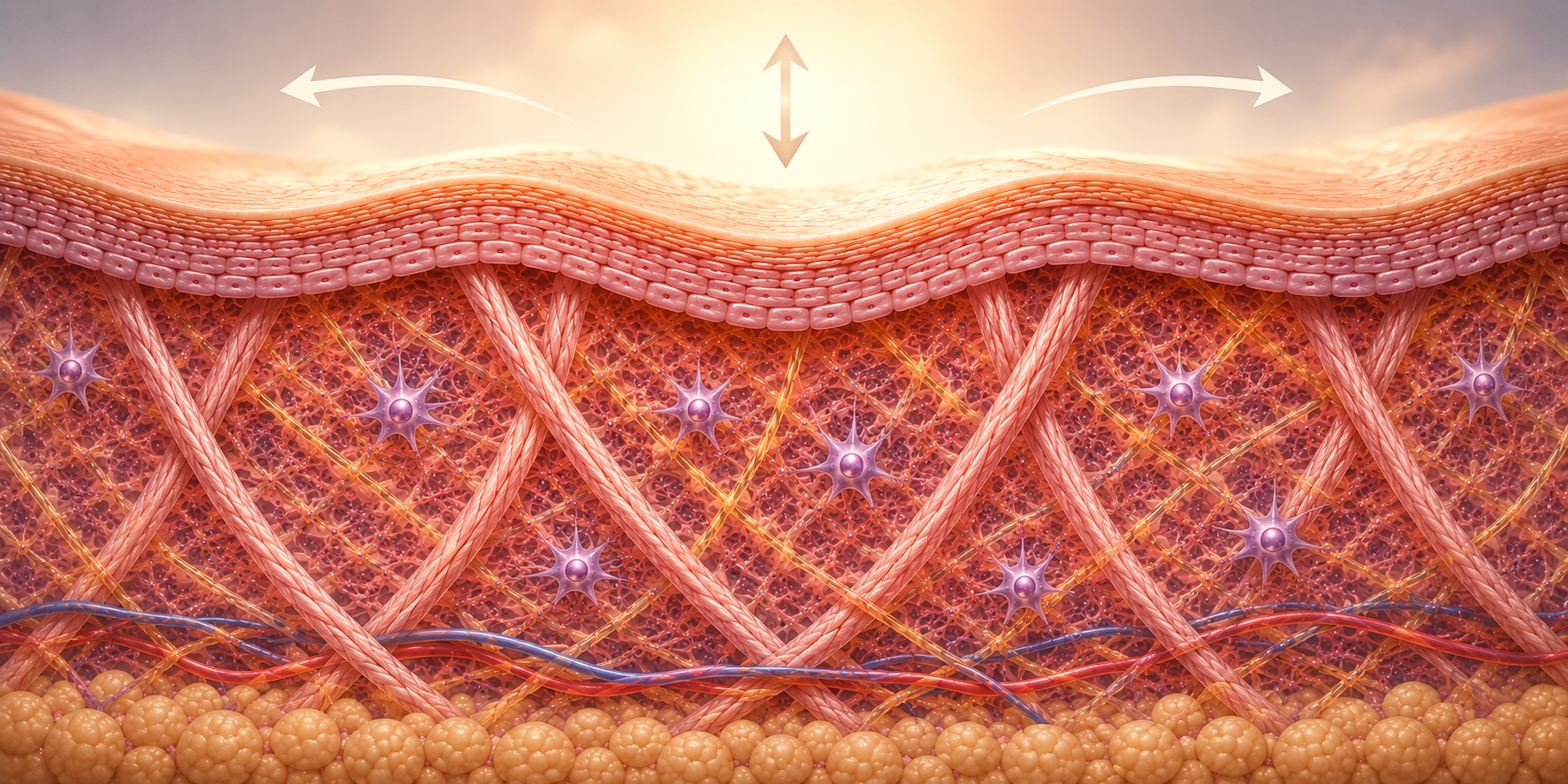
Elastin is one of the major structural proteins found within the dermis—the middle layer of the skin beneath the epidermis. While collagen provides strength and support, elastin provides flexibility.
Together they create a framework that is both stable and adaptable.
An easy way to picture the difference is to imagine a quality mattress.
- The frame provides strength.
- The springs provide flexibility.
- The fabric creates the surface.
Without the springs, the mattress would quickly lose its ability to recover after pressure. Elastin performs a similar role inside healthy skin.

Why is Elastin Important?
Unlike collagen, which resists pulling forces, elastin allows tissues to deform and then recover.
Scientists often describe this property as elastic recoil.
Imagine stretching a rubber band.
As soon as you let go, it returns to its original length.
Healthy elastin fibres behave in a similar way.
This allows skin to:
- Stretch during facial expressions
- Adapt to everyday movement
- Return to its original position
- Help maintain smooth skin texture
- Support overall skin resilience
Elastin isn't only found in skin.
It is also present in:
- Blood vessels
- Lungs
- Ligaments
- Tendons
- Certain connective tissues throughout the body
Everywhere flexibility is required, elastin plays an important role.
Collagen and Elastin Work Together
Collagen and elastin are often mentioned together because they perform complementary jobs.
Think of constructing a suspension bridge.
The supporting pillars provide strength.
The flexible cables allow movement without collapse.
Healthy skin relies on the same partnership.
Collagen creates structure.
Elastin creates flexibility.
Neither works as effectively without the other.
🧠 Did You Know?
Your body produces far less new elastin than collagen throughout adult life. Many elastin fibres formed during childhood and adolescence remain with you for decades, making them especially valuable to protect.
How Elastin Is Made
Like collagen, elastin is produced by specialised cells called fibroblasts.
Fibroblasts live within the dermis and are responsible for building much of the skin's supportive framework.
Creating elastin is surprisingly complex.
Fibroblasts first produce a protein called tropoelastin.
These molecules are then assembled into elastic fibres with the help of several supporting proteins, forming a durable network capable of stretching thousands of times during life.
Because this process is highly organised, damaged elastin is difficult for the body to replace completely.
This is one reason protecting existing elastin is so important.

Why Does Elastin Change Over Time?
Like every part of our skin, elastin naturally changes throughout life.
These changes happen gradually and are influenced by both intrinsic ageing (our natural biology) and extrinsic ageing (our environment).
Natural Ageing
As we get older:
- Fibroblasts become less active.
- Existing elastic fibres experience years of wear.
- New elastin production becomes limited.
These gradual changes contribute to skin becoming less springy over time.
Sun Exposure
Ultraviolet (UV) radiation is one of the biggest environmental influences on elastin.
Repeated UV exposure activates enzymes that break down components of the skin's supportive framework.
Over many years this contributes to a process called solar elastosis, where normal elastic fibres become disorganised and less functional.
This is one reason sunscreen is considered one of the most effective long-term strategies for maintaining healthy-looking skin.
Lifestyle Factors
Other influences include:
- Smoking
- Air pollution
- Chronic inflammation
- Oxidative stress
- Poor sleep
- High cumulative sun exposure
None of these causes immediate visible changes, but over many years they can influence how well the skin maintains its supportive structures.
💡 Joanne's Insight
One of the biggest misconceptions I see in clinic is that firmness only depends on collagen. In reality, skin that feels resilient also relies on healthy elastin. Protecting your skin every day—particularly from UV exposure—is often far more valuable than trying to "replace" what has already been lost.
Can Elastin in Skincare Replace Elastin?
This is a question many people ask.
The simple answer is:
Not directly.
Elastin molecules are far too large to pass through the skin and become incorporated into your existing elastic fibre network.
Products containing elastin can certainly help moisturise the surface of the skin, but they cannot rebuild damaged elastin fibres within the dermis.
Instead, modern skincare focuses on creating an environment that supports healthy skin function.
Ingredients that may assist include:
- Retinoids that encourage normal skin renewal
- Antioxidants that help defend against oxidative stress
- Peptides that support healthy skin biology
- Moisturisers that strengthen the skin barrier
- Broad-spectrum sunscreen to reduce UV damage
These ingredients do not replace elastin.
Rather, they help support healthier skin over time.
❌ Myth vs ✅ Reality
Myth: Elastin creams replace the elastin you've lost.
Reality: Topical elastin cannot rebuild your skin's elastic fibre network. Healthy skincare focuses on supporting the skin and protecting the elastin you already have.

Why Protection Matters More Than Replacement
One of the most valuable lessons in skincare is that prevention is usually easier than restoration.
Because elastin is difficult for the body to replace, preserving healthy fibres becomes especially important.
Daily habits make a meaningful difference over many years.
These include:
- Wearing broad-spectrum sunscreen every day
- Using antioxidants alongside sun protection
- Supporting the skin barrier
- Avoiding excessive sun exposure
- Following a consistent skincare routine
- Living a healthy lifestyle
None of these habits stop ageing.
Instead, they help your skin age as healthily as possible.
✨ Why It Matters
When people describe skin as "bouncy," "supple" or "springy," they're often describing healthy elastin working together with collagen and hydration. Understanding elastin helps explain why consistency and prevention usually deliver better long-term outcomes than constantly searching for dramatic treatments.
What Does This Mean for Your Skincare Routine?
Knowing about elastin changes how we think about skincare.
Rather than chasing impossible promises, we begin focusing on habits that support healthy skin for decades.
A simple routine should prioritise:
- Gentle cleansing
- Daily moisturising
- Broad-spectrum SPF every morning
- Antioxidants during the day where appropriate
- Vitamin A or retinoid products when suitable
- Patience and consistency
Healthy skin is built through thousands of small decisions made over many years.
👩⚕️ Skin Therapist Tip
If you're investing in one anti-ageing habit, make it daily sunscreen. UV exposure is one of the biggest contributors to long-term changes in both collagen and elastin, making consistent sun protection one of the simplest and most effective ways to support your skin's natural resilience.

Conclusion
Elastin is one of the quiet achievers of healthy skin.
Although it rarely receives the same attention as collagen, it allows your skin to move comfortably through every smile, expression and movement before returning to its natural shape.
While elastin naturally changes with age, healthy skincare is not about stopping this process. It is about protecting what your skin already has, supporting normal skin function and creating the best possible environment for long-term skin health.
Understanding elastin reminds us that resilient skin is never built overnight. It is supported through consistent care, realistic expectations and everyday habits that protect the remarkable biology beneath the surface.
Key Takeaways
- Elastin gives skin its flexibility and ability to return to shape after stretching.
- Elastin and collagen work together to support healthy skin structure.
- Fibroblasts produce elastin within the dermis.
- Existing elastin is difficult for the body to replace once damaged.
- UV exposure is one of the biggest contributors to elastin breakdown over time.
- Daily sunscreen and antioxidants help protect the skin's supportive framework.
- Consistent skincare supports healthier skin over the long term.
Continue Your Learning
Now that you understand how elastin helps skin remain flexible and resilient, the next lesson explores another important part of healthy skin ageing: Inflammation Explained.

You'll learn how inflammation supports healing when it's well controlled, how chronic inflammation can gradually affect the skin, and why calming unnecessary inflammation is an important part of maintaining healthy skin over time. Go to next lesson