Inflammation Explained
Inflammation often has a negative reputation, yet it is one of the body's most important protective systems. Every day, your skin quietly responds to sunlight, pollution, bacteria, friction and tiny injuries through carefully controlled inflammation. Without it, wounds would never heal and infections could quickly spread. The challenge isn't inflammation itself—it's when this natural response becomes excessive or continues for longer than it should. Understanding how inflammation works helps explain why healthy skincare is about supporting balance, not eliminating the body's natural defence mechanisms.

Understanding Inflammation
Inflammation is your body's natural emergency response system.
Whenever your skin detects damage, irritation or invading microorganisms, it immediately begins coordinating a highly organised response designed to protect, clean up and restore healthy tissue.
Although we often associate inflammation with redness or swelling, most inflammatory activity happens quietly beneath the surface without us ever noticing.
In many ways, inflammation is less like an alarm and more like an experienced emergency response team. It quickly assesses the situation, sends the right specialists, repairs the damage and then stands down once the job is complete.
Healthy skin relies on this process every single day.
What triggers inflammation?
Your skin may trigger inflammation in response to:
- Small cuts and scratches
- UV exposure from sunlight
- Bacteria and viruses
- Allergens
- Pollution
- Friction
- Harsh skincare products
- Chemical irritants
- Certain skin conditions such as eczema or acne
Not every trigger causes visible redness.
Many inflammatory responses remain microscopic and resolve long before you notice any changes.
💡 Joanne's Insight
One of the biggest misconceptions I see in clinic is that all redness means the skin needs stronger treatment. In reality, redness is often a sign that the skin is already working hard to protect itself. Supporting the skin barrier is frequently more beneficial than trying to aggressively "fight" the inflammation.
Controlled Inflammation: Your Skin's Natural Defence
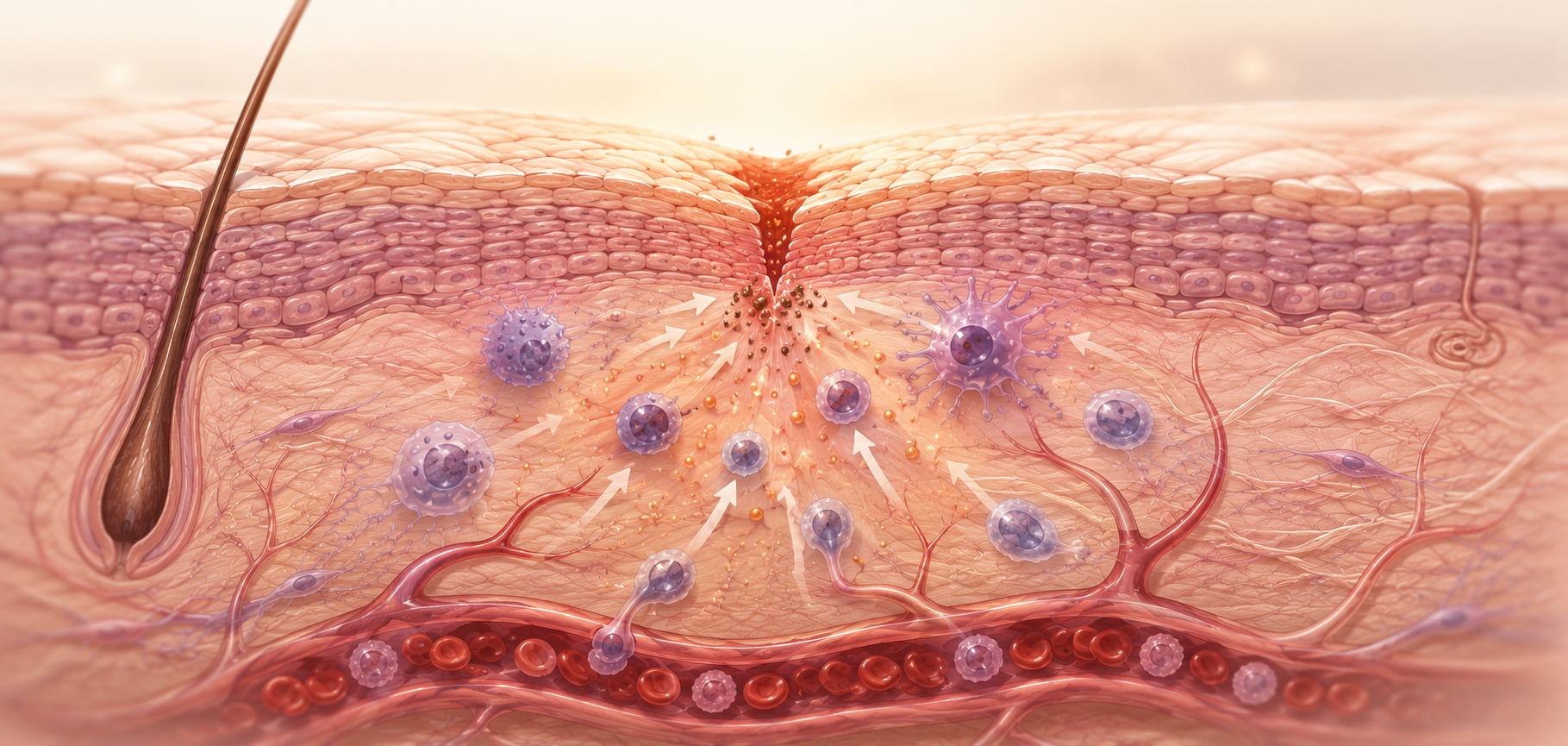
Inflammation follows an incredibly organised sequence.
Rather than creating chaos, your immune system carefully coordinates thousands of chemical signals that communicate exactly what needs to happen.
This process usually follows four broad stages.
1. Detecting the problem
Specialised cells recognise that something has disturbed normal skin function.
This could be a small injury, invading bacteria or damage caused by ultraviolet radiation.
2. Calling for help
Chemical messengers are released.
These tiny signalling molecules tell nearby blood vessels and immune cells that assistance is needed.
Blood vessels widen slightly, allowing more immune cells to reach the affected area.
This explains why inflamed skin often appears warmer or slightly red.
3. Cleaning up
Different immune cells remove damaged tissue, destroy harmful microorganisms and clear away debris.
Think of them as highly trained cleaners preparing the area for rebuilding.
4. Healing and rebuilding
Once the danger has passed, fibroblasts begin producing new collagen while skin cells gradually restore the surface.
Finally, the inflammatory signals switch off.
The tissue returns to its normal balanced state.
This final step is just as important as the first.
Healthy inflammation always knows when to stop

🧠 Did You Know?
Your skin contains millions of resident immune cells that constantly patrol the epidermis, even when your skin appears completely healthy.
When Inflammation Lasts Too Long
Problems arise when inflammation doesn't resolve properly.
Scientists refer to this as chronic inflammation.
Instead of helping the skin heal, persistent inflammation can gradually begin affecting healthy tissue.
Unlike acute inflammation, which resolves within days, chronic inflammation may continue for weeks, months or even years.
Sometimes it develops because the original trigger remains present.
Other times, the immune response itself struggles to switch off completely.
Common causes of persistent skin inflammation include:
- Repeated UV exposure
- Ongoing irritation from harsh skincare
- A weakened skin barrier
- Chronic inflammatory skin conditions
- Smoking
- Air pollution
- Persistent stress
- Poor sleep
Because chronic inflammation is often low-grade, people may simply notice that their skin feels consistently reactive rather than obviously inflamed.
They may experience:
- Ongoing redness
- Increased sensitivity
- Frequent irritation
- Slower recovery after treatments
- More noticeable dehydration
- Uneven skin tone
- This is why supporting the skin's natural balance is often more effective than constantly trying to "fix" visible symptoms alone.
❌ Myth vs ✅ Reality
Myth: Inflammation is always harmful.
Reality: Healthy inflammation is essential for protection and healing. Problems usually occur when inflammation becomes excessive, repetitive or prolonged.
The Link Between Inflammation and Skin Ageing
Scientists increasingly recognise inflammation as one contributor to visible skin ageing.
This doesn't mean inflammation causes ageing on its own.
Rather, repeated inflammation gradually places extra demands on the skin's repair systems.
Each inflammatory episode requires energy and resources.
When these episodes happen repeatedly—particularly through years of sun exposure—the balance between damage and repair slowly changes.
Researchers sometimes refer to this gradual process as "inflammageing."
Over many years, chronic low-level inflammation may contribute to:
- Reduced collagen support
- Gradual elastin changes
- Increased oxidative stress
- Slower tissue repair
- Uneven pigmentation
- Reduced barrier resilience
- Importantly, these changes develop gradually over decades rather than appearing suddenly.
This is one reason why daily sun protection remains one of the most evidence-supported ways to support healthy skin ageing.

✨ Why It Matters
Inflammation isn't something to fear—it's something to respect. By protecting your skin from unnecessary irritation while supporting its natural repair processes, you help your skin spend more time maintaining itself and less time responding to avoidable stress.
Supporting Healthy Inflammation
The goal of good skincare is not to eliminate inflammation.
Instead, it is to minimise unnecessary triggers while supporting the skin's ability to recover efficiently.
Healthy habits include:
Protect from UV exposure
Daily sunscreen helps reduce one of the largest sources of repeated inflammation.
Support the skin barrier
An intact barrier reduces irritation from environmental stressors.
Avoid over-exfoliation
More exfoliation doesn't necessarily mean healthier skin.
Overusing acids or scrubs may increase irritation.
Choose gentle cleansing
Harsh cleansing can strip protective lipids and increase sensitivity.
Prioritise hydration
Well-hydrated skin generally tolerates environmental stress more comfortably.
Use antioxidants
Antioxidants help neutralise free radicals generated during environmental exposure, supporting the skin's natural protective systems.
Maintain consistency
Healthy skin usually responds better to steady routines than frequent product changes.
👩⚕️ Skin Therapist Tip
If your skin suddenly becomes red, tight or unusually sensitive, simplify your routine for a few days. Focus on gentle cleansing, moisturising and sun protection while avoiding unnecessary active ingredients until your skin feels comfortable again.
Inflammation Is Part of Healthy Skin
It can seem surprising, but healthy skin is constantly balancing tiny inflammatory responses with equally active repair processes.
Every scrape that heals, every blemish that resolves and every day spent outdoors requires careful communication between your immune system and your skin.
The aim isn't to stop inflammation.
It's to allow this remarkable system to work exactly as nature intended—quickly, efficiently and only when needed.
When inflammation remains balanced, your skin is better able to protect itself, heal itself and maintain its natural resilience over time.

Conclusion
Inflammation is one of the body's most sophisticated protective systems. It helps defend against infection, coordinates healing and maintains healthy skin throughout life. While short-term inflammation is essential, repeated or prolonged inflammation can gradually place additional stress on the skin.
Supporting healthy skin isn't about eliminating inflammation—it is about giving your skin the conditions it needs to respond appropriately and recover well. Gentle skincare, daily sun protection and a consistent routine all contribute to maintaining this delicate balance.
The more you understand inflammation, the easier it becomes to make skincare choices that support long-term skin health rather than simply reacting to temporary symptoms.
Key Takeaways
- Inflammation is a normal and essential part of healthy skin.
- Healthy inflammation protects against injury and infection.
- Problems arise when inflammation becomes chronic or excessive.
- UV exposure is one of the most common causes of repeated skin inflammation.
- Supporting the skin barrier helps reduce unnecessary inflammatory stress.
- Gentle, consistent skincare supports healthy recovery.
- Balanced inflammation contributes to healthier, more resilient skin over time.
Continue Your Learning
Inflammation and healing work hand in hand. Now that you understand how the skin responds to damage, continue to the next lesson: Skin Healing & Repair, where you'll discover how immune cells, fibroblasts and collagen work together to rebuild healthy skin after injury.