
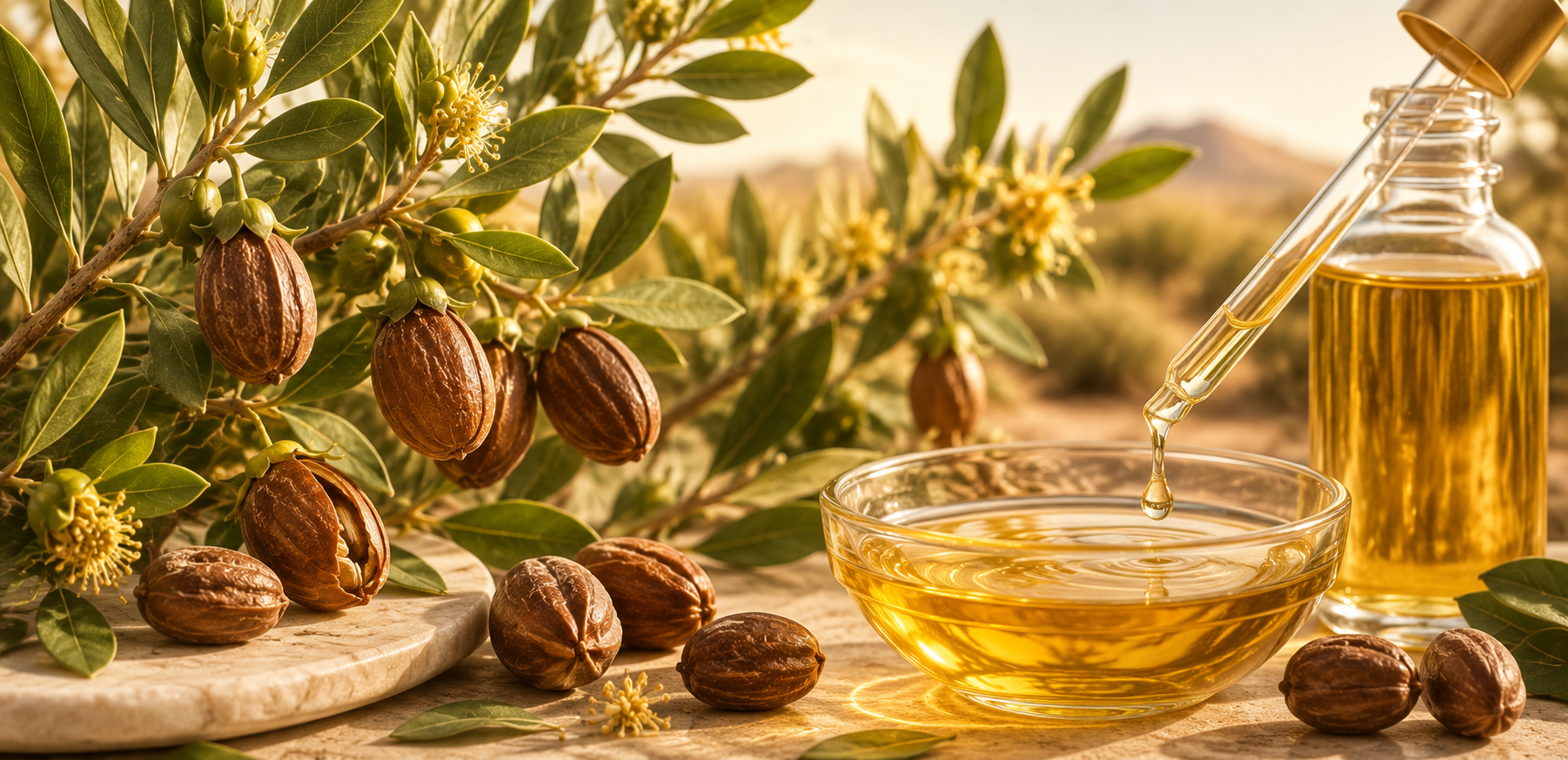
Jojoba Oil: Nature's Closest Match to Healthy Skin
Few botanical ingredients have earned the reputation that jojoba oil enjoys. Loved by skin therapists, formulators and researchers alike, jojoba oil is remarkably similar to the skin's own natural protective oils. Rather than simply coating the surface, it helps support the skin barrier, maintain comfortable hydration and soften the complexion without feeling heavy. Whether your skin is dry, oily, combination or sensitive, jojoba oil is one of the rare ingredients that can complement almost every skincare routine.

Full Lesson
What Is Jojoba Oil?
Although we call it an oil, jojoba oil is technically a liquid plant wax extracted from the seeds of the Simmondsia chinensis shrub, native to the deserts of North America.
This distinction is more important than it sounds.
Most plant oils are made primarily of triglycerides (fatty acids attached to glycerol). Jojoba oil, however, is composed mainly of long-chain wax esters.
Interestingly, human sebum—the natural oil produced by our skin—also contains wax esters.
This remarkable similarity helps explain why jojoba feels so comfortable on the skin and why it integrates so naturally into the skin barrier.
Rather than sitting heavily on the surface, jojoba behaves more like an extension of the skin's own protective lipid layer.

How Does Jojoba Oil Work?
The outer layer of the skin, called the stratum corneum, relies on a carefully organised mixture of skin cells and lipids to keep moisture in and environmental stress out.
When this barrier becomes depleted, skin may feel:
- dry
- rough
- tight
- flaky
- more easily irritated
Jojoba oil supports this barrier in several ways.
It reinforces the skin's protective lipids
The wax esters help supplement the skin's natural surface oils, improving softness while reducing moisture loss.
It slows water evaporation
By forming a lightweight breathable layer, jojoba helps reduce transepidermal water loss (TEWL), allowing hydration to remain within the skin.
It softens rough skin
Its emollient properties smooth the spaces between dry skin cells, creating softer, more comfortable skin.
It supports barrier recovery
Healthy skin barriers recover more effectively when they have adequate lipids, hydration and protection from unnecessary irritation.
Rather than dramatically changing the skin, jojoba helps the skin function as it naturally should.
Why Doesn't Jojoba Feel Greasy?
One reason jojoba is so widely used is its elegant skin feel.
Unlike some richer botanical oils, jojoba spreads easily, absorbs well and leaves only a soft, silky finish.
Its wax ester structure is highly stable, meaning it is less likely to become rancid than many traditional plant oils.
For formulators, this stability is valuable.
For consumers, it means products containing jojoba often remain pleasant to use while helping maintain a lightweight finish.
💡 Joanne's Insight
One of the reasons I've used jojoba oil for so many years is because it rarely overwhelms the skin. Whether someone has dry, oily or combination skin, jojoba usually feels comfortable. It provides nourishment without leaving that heavy feeling many people associate with facial oils.
Is Jojoba Oil Good for Oily Skin?
Surprisingly, yes.
Many people with oily skin avoid facial oils altogether, believing they'll make shine or congestion worse.
In reality, skin still needs healthy lipids to maintain its protective barrier.
Jojoba's lightweight nature allows it to provide nourishment without the heavy feel associated with richer oils.
Some research also suggests jojoba may help maintain a balanced skin surface because of its similarity to natural sebum, although it does not "switch off" oil production or permanently regulate sebaceous glands.
Instead, it supports a healthier skin environment where the barrier remains comfortable and hydrated.
❌ Myth vs ✅ Reality
Myth: People with oily skin should never use facial oils.
Reality: The right botanical oils—particularly lightweight oils like jojoba—can support the skin barrier without necessarily making skin feel oilier.

Which Skin Types Benefit Most?
One of jojoba's greatest strengths is its versatility.
It is suitable for many different skin types because its primary role is supporting healthy barrier function rather than aggressively changing skin behaviour.
Jojoba may be especially beneficial for:
- Dry skin needing additional nourishment
- Dehydrated skin lacking water retention
- Sensitive skin requiring gentle barrier support
- Mature skin experiencing reduced natural lipids
- Combination skin needing lightweight hydration
- Oily skin seeking comfortable moisturisation
This flexibility explains why jojoba appears in cleansers, moisturisers, facial oils, serums and even lip care.
🧠 Did You Know?
Jojoba shrubs can live for more than 100 years in harsh desert conditions. The protective wax stored inside their seeds helps them survive extreme heat and drought—a quality that also makes jojoba remarkably stable in skincare formulations.
Jojoba Oil and the Skin Barrier
Modern skincare increasingly focuses on supporting the skin barrier rather than stripping or over-treating the skin.
This is where jojoba excels.
Healthy skin barriers depend upon a balanced mixture of:
- ceramides
- cholesterol
- fatty acids
- natural surface lipids
- adequate hydration
Jojoba complements these systems by helping reinforce the protective lipid layer while remaining exceptionally skin compatible.
When combined with ingredients such as ceramides, hyaluronic acid, beta glucan or panthenol, jojoba contributes to an environment where skin feels softer, calmer and more resilient.
✨ Why It Matters
Healthy skin isn't achieved by using the strongest ingredients available—it's achieved by supporting the skin so it can perform its natural functions well. Jojoba oil is an excellent example of an ingredient that works with the skin rather than against it, making it suitable for long-term daily care.
Where You'll Find Jojoba Oil in Skincare
Because of its versatility, jojoba is incorporated into many different product types.
It may be found in:
- Cleansers
- Facial oils
- Moisturisers
- Barrier creams
- Brightening serums
- Lip treatments
- Body oils
- Haircare
Its compatibility with almost every skin type makes it one of the most widely used botanical oils in modern skincare formulations.
👩⚕️ Skin Therapist Tip
If you're introducing a facial oil for the first time, choose one containing jojoba oil and apply just two or three drops over your moisturiser in the evening. This helps lock in hydration while allowing you to see how your skin responds before adding richer oils.

Jojoba Oil in the Shanga Collection
Jojoba oil is included in several Shanga formulations where its lightweight, barrier-supportive properties complement other active ingredients. You'll find it in:
- Glow Cleanser
- Vibran-C Serum
- Purify Moisturiser
- Calm Moisturiser
- Hydrate Moisturiser
- Radiance Elixir
Each formulation combines jojoba with different botanical oils and active ingredients to support specific skincare goals while maintaining skin comfort.
Conclusion
Jojoba oil has earned its place as one of skincare's most respected botanical ingredients because it works in harmony with the skin. Its unique wax ester composition closely resembles the skin's own protective oils, allowing it to support the barrier, reduce moisture loss and soften the complexion without feeling heavy.
Rather than promising dramatic transformation, jojoba quietly helps the skin maintain balance—something that benefits almost every skin type. Its versatility, stability and compatibility make it a timeless ingredient that continues to be valued by skin therapists and formulators around the world.
Key Takeaways
- Jojoba oil is technically a liquid plant wax rather than a traditional oil.
- Its wax esters closely resemble the skin's own natural sebum.
- It helps support the skin barrier and reduce moisture loss.
- Jojoba feels lightweight and is suitable for most skin types.
- It complements ingredients such as ceramides and hyaluronic acid.
- Healthy skin depends on balanced barrier support as much as active ingredients.
- Jojoba is one of the most versatile botanical ingredients used in modern skincare.
Continue Your Learning
Jojoba oil helps protect and support the skin barrier, but another remarkable botanical oil offers something slightly different. Rosehip oil is naturally rich in essential fatty acids and provitamin A compounds that have made it a favourite for supporting skin renewal, improving the appearance of uneven skin tone and maintaining healthy-looking skin. In the next lesson, we'll explore the science behind rosehip oil and discover why it has become one of the world's most celebrated facial oils. Next lesson