Peptides: The Skin's Tiny Messengers
Every second, your skin is sending and receiving countless biological messages. These tiny signals help coordinate everything from wound healing to collagen production and barrier maintenance. Peptides are inspired by these natural messengers. When applied through skincare, they can help support the skin's own communication systems, encouraging healthy biological processes rather than forcing change. While they are not miracle ingredients, peptides have become one of the most respected technologies in modern skincare because they work in harmony with the skin's natural biology.

Full Lesson
What Are Peptides?
Peptides are short chains of amino acids, the building blocks that make up proteins throughout the body.
Many of the proteins that give skin its strength, elasticity and resilience—including collagen and elastin—are built from amino acids. Peptides are simply much shorter sections of these protein chains.
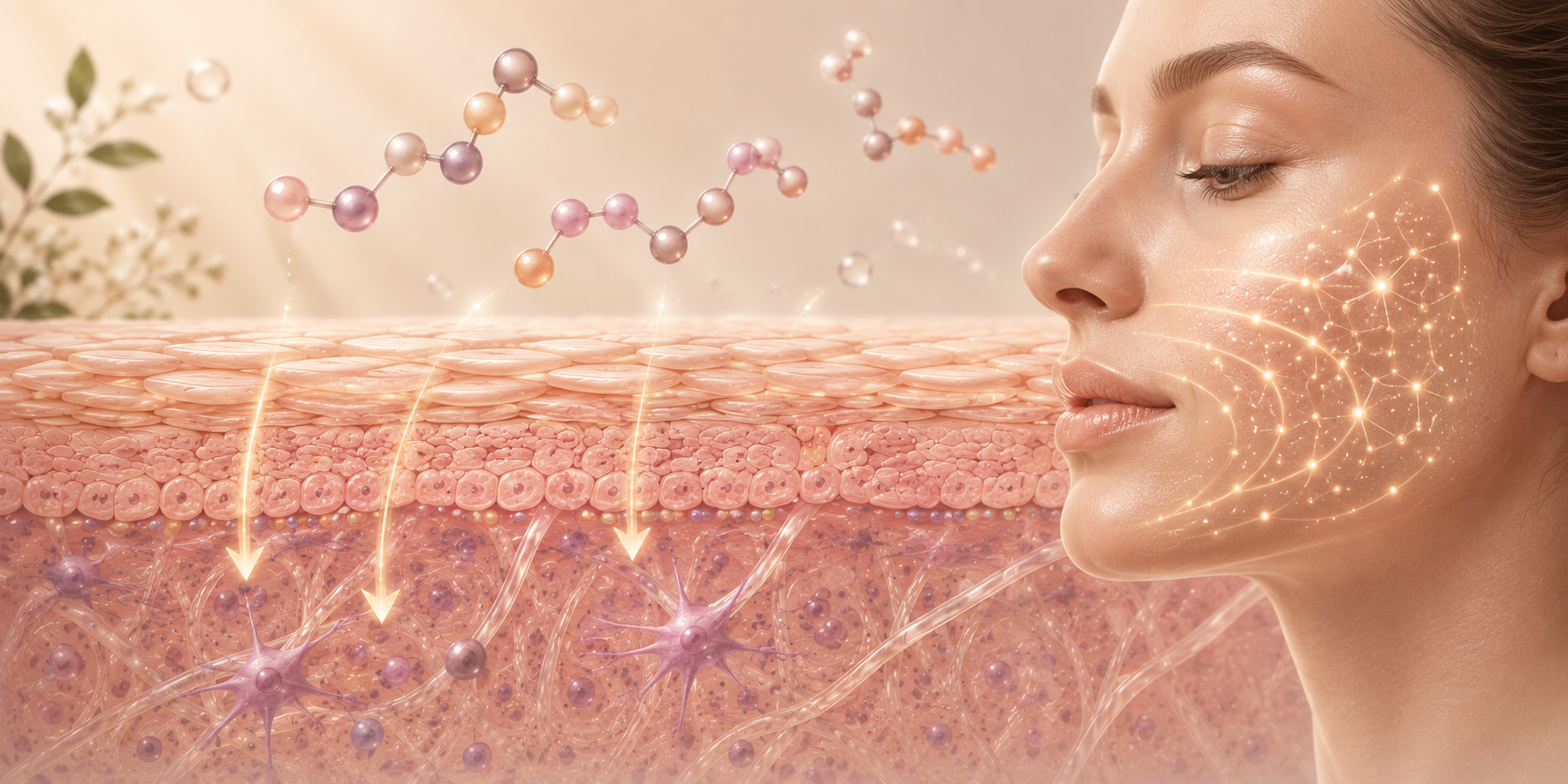
What makes peptides particularly interesting is that many act as biological messengers.
Instead of becoming collagen themselves, they help send signals that encourage skin cells to carry out normal healthy functions.
Think of them as tiny text messages travelling through the skin.
Rather than doing the work themselves, they tell skin cells what may need attention.
Some peptides help support collagen production.
Others help improve hydration, strengthen the skin barrier or soften the appearance of expression lines.
This ability to communicate with skin biology is why peptides have become such an important area of cosmetic science.
🧠 Did You Know?
Your body naturally produces thousands of different peptides. Scientists continue discovering new peptide sequences that may help support healthy skin in different ways.

How Do Peptides Work?
Unlike exfoliating acids or vitamin A, peptides don't work by speeding up skin renewal or removing surface cells.
Instead, they communicate.
Skin cells constantly respond to chemical signals.
Certain cosmetic peptides are designed to mimic some of these naturally occurring signals.
When recognised by the skin, they may encourage processes involved in maintaining healthy-looking skin.
Depending on the peptide, this may include supporting:
- collagen production
- elastin maintenance
- skin firmness
- barrier function
- hydration
- smoother-looking skin
- recovery after everyday environmental stress.
Not every peptide performs the same job.
In fact, there are hundreds of different cosmetic peptides, each with unique functions.
Some of the most common include:
Signal Peptides
These encourage skin to maintain healthy collagen and extracellular matrix proteins.
Carrier Peptides
These help deliver important minerals involved in normal skin function.
Neurotransmitter-Inspired Peptides
These help soften the appearance of expression lines by influencing how skin responds around facial muscles.
Enzyme-Inhibiting Peptides
These may help reduce the breakdown of important structural proteins over time.
Rather than relying on one peptide, many advanced formulations combine several complementary peptides to support multiple pathways simultaneously.
💡 Joanne's Insight
When clients ask whether peptides are "better" than vitamin A or vitamin C, my answer is always the same—they do different jobs.
Healthy skin isn't supported by one miracle ingredient. It's the combination of ingredients working together over time that makes the biggest difference.

Peptides and Collagen: Why They're Often Mentioned Together
Collagen is the most abundant structural protein in the dermis.
It provides much of the skin's strength and support.
As we age, collagen production gradually slows.
Environmental factors such as ultraviolet (UV) exposure and oxidative stress can also influence collagen over time.
Peptides cannot replace lost collagen.
Instead, certain peptides help support the skin's normal collagen-producing cells, called fibroblasts.
This means peptide skincare supports healthy skin biology rather than artificially replacing structural proteins.
Because collagen naturally changes slowly, improvements associated with peptide skincare also develop gradually.
Consistency is far more important than intensity.
Most people who enjoy peptide skincare use it as part of a long-term routine rather than expecting rapid change.
❌ Myth vs ✅ Reality
Myth: Peptides build new collagen overnight.
Reality: Peptides simply support the skin's natural biological processes. Any visible improvements develop gradually through consistent skincare and healthy skin function.
Why Peptides Work Well With Other Ingredients
One reason peptides are so popular is their flexibility.
Unlike some active ingredients that require careful introduction, most cosmetic peptides are compatible with many other skincare ingredients.
They are commonly paired with:
- niacinamide
- hyaluronic acid
- ceramides
- antioxidants
- vitamin C derivatives
- retinal and retinol (when formulated appropriately).
This allows peptides to become part of a balanced routine rather than replacing other beneficial ingredients.
Many modern formulations combine multiple ingredients because healthy skin depends on many biological systems working together.
Hydration, barrier health, collagen support and antioxidant protection all influence one another.
✨ Why It Matters
Healthy skin isn't supported by collagen alone.
Peptides are valuable because they help support several interconnected systems that contribute to stronger, more resilient skin over time.

Who Can Benefit From Peptides?
Peptides are suitable for many skin types because they work alongside the skin's natural biology.
They may be especially useful for people wanting to support:
- healthy skin ageing
- fine lines
- loss of firmness
- skin resilience
- barrier function
- overall skin health.
They also fit well into preventative skincare.
Supporting healthy skin before significant visible changes occur is often easier than trying to address changes later.
Importantly, peptides are not reserved for mature skin.
Healthy collagen and barrier function matter at every age.
👩⚕️ Skin Therapist Tip
If you're introducing peptides, don't look for overnight changes.
Take photographs every six to eight weeks in consistent lighting. Small improvements in overall skin quality are often easier to appreciate over time than from day to day.
Peptide Products Within the Shanga Collection
Several Shanga formulations include carefully selected peptides to support healthy skin biology.
Current peptide-containing products include:
- B-Strong Serum – features Acetyl Hexapeptide-1 alongside niacinamide, antioxidants and barrier-supporting ingredients.
- Vibran-C Serum – contains Acetyl Hexapeptide-1, Trifluoroacetyl Tripeptide-2 and Heptapeptide-8, combined with vitamin C derivatives and botanical antioxidants.
- Renew Eye Cream – includes a multi-peptide complex featuring Acetyl Hexapeptide-8, Palmitoyl Tripeptide-1 and Palmitoyl Tetrapeptide-7, alongside retinal, ceramides and multiple forms of hyaluronic acid.
- De-Light SPF – incorporates Acetyl Hexapeptide-51 Amide together with broad-spectrum UV filters and hydrating ingredients.
Each formulation pairs peptides with complementary ingredients, recognising that healthy skin relies on multiple supportive pathways rather than a single active ingredient.

Conclusion
Peptides represent one of the most exciting developments in modern skincare because they work with the skin instead of against it.
Rather than forcing rapid change, they support the natural communication systems that help maintain healthy skin over time.
Used consistently alongside sunscreen, hydration, barrier-supporting ingredients and a balanced skincare routine, peptides can become an important part of maintaining healthy, resilient skin.
Like most good skincare, their greatest strength isn't dramatic transformation—it's supporting healthy skin biology day after day.
Key Takeaways
- Peptides are short chains of amino acids that act as biological messengers.
- Different peptides support different skin functions.
- Many peptides help support healthy collagen production.
- Results develop gradually through consistent use.
- Peptides work well alongside ingredients such as vitamin C, niacinamide, ceramides and hyaluronic acid.
- They are suitable for many skin types and ages.
- Healthy skin benefits from multiple supportive ingredients working together.
Continue Your Learning
Peptides help skin communicate effectively, but healthy skin also depends on maintaining adequate water levels. In the next lesson, Hyaluronic Acid Explained, you'll discover how one of skincare's most celebrated hydration ingredients attracts and holds water within the skin, supporting comfort, resilience and a healthy-looking complexion.