Skin Layers Explained
Your skin may appear smooth on the surface, but beneath it lies an incredibly organised living structure. Every layer has a different role, from protecting you against the outside world to producing collagen, regulating temperature and supporting healing. Understanding these layers makes it much easier to understand why different skincare ingredients work where they do—and why healthy skin is always the result of many systems working together rather than one miracle product. 
Full Lesson
Healthy Skin Is Built in Layers
The skin is the body's largest organ, covering almost two square metres in the average adult. Although we often think of it as a single surface, it is actually made up of multiple specialised layers that work together every second of every day.
Each layer performs different tasks.
Some create a protective barrier.
Others produce new skin cells.
Some provide strength and elasticity.
Others deliver nutrients, regulate temperature and cushion the body.
Together they create one remarkably efficient system.
Understanding these layers helps explain why some skincare products work on the surface, while others are designed to support the skin's natural biological processes.
Healthy skin isn't just about what you can see.
It's about everything happening beneath the surface.
💡 Joanne's Insight
One of the biggest shifts I see in clients happens when they realise skincare isn't about "fixing" skin. It's about supporting what healthy skin is already designed to do. Once you understand the different layers, your routine becomes much more logical and far less overwhelming.

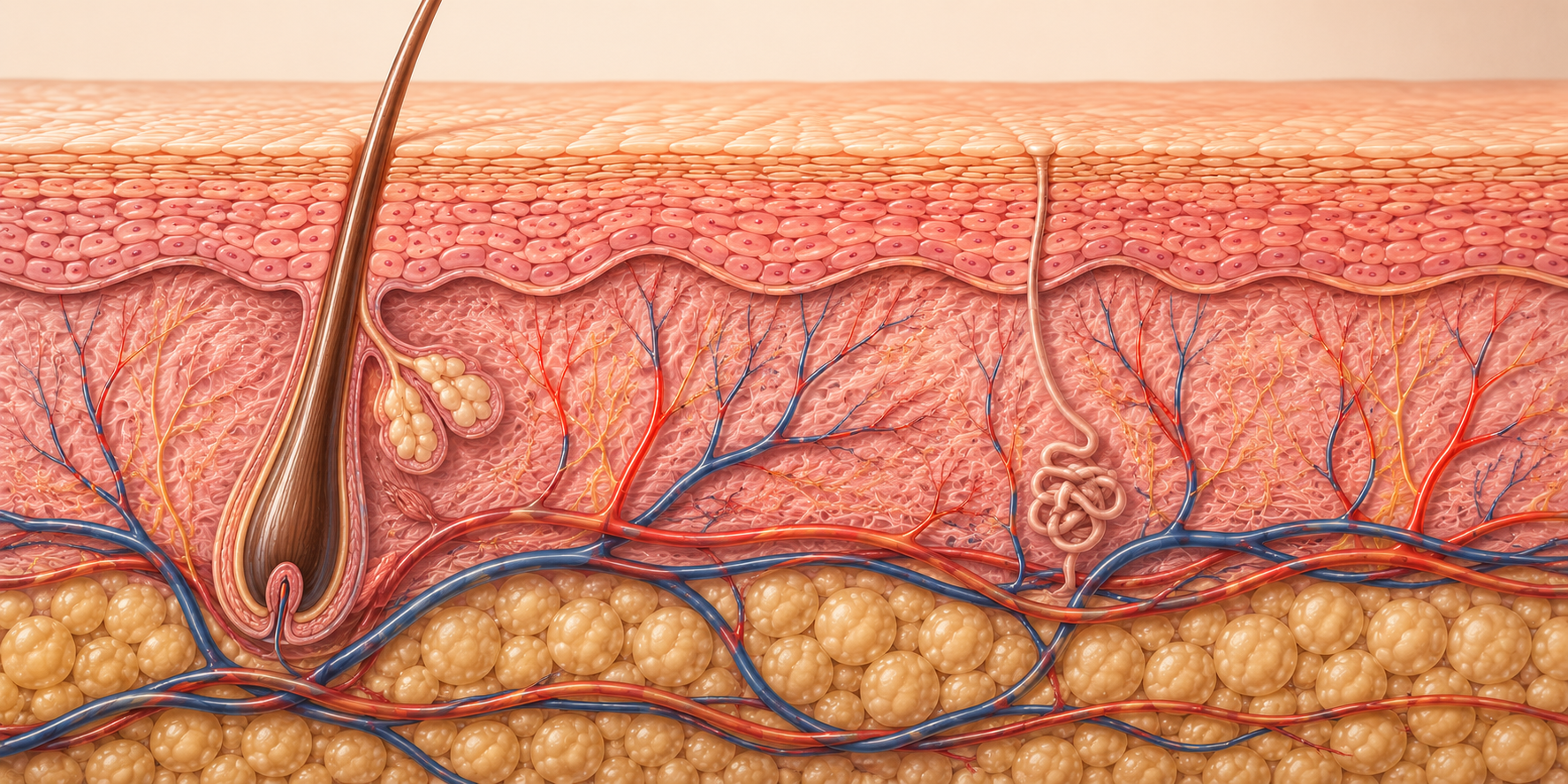
The epidermis is the thin outer layer that you can see and touch.
Although it measures less than one millimetre thick across most of the body, it performs one of the most important jobs in the human body—protecting everything underneath.
The epidermis acts as your first line of defence against:
- UV radiation
- Pollution
- Bacteria
- Viruses
- Irritants
- Water loss
Its outermost portion is called the stratum corneum, often referred to as the skin barrier.
This barrier is made from flattened skin cells surrounded by specialised lipids that work together much like bricks held together by mortar.
The epidermis is constantly renewing itself.
New skin cells are created deep within the epidermis before slowly moving upward over several weeks.
As they travel, they become flatter, stronger and more protective until they naturally shed from the surface.
This continuous renewal helps maintain healthy skin throughout life.
🧠 Did You Know?
Your body sheds millions of skin cells every day. Most household dust contains tiny amounts of naturally shed skin cells mixed with fibres and other particles.
The Dermis: Where Strength and Support Live

Beneath the epidermis lies the dermis.
This thicker middle layer gives skin much of its strength, flexibility and resilience.
Unlike the epidermis, the dermis contains:
- Collagen fibres
- Elastin fibres
- Blood vessels
- Nerve endings
- Hair follicles
- Sweat glands
- Sebaceous (oil) glands
The dermis is home to specialised cells called fibroblasts.
These remarkable cells continually produce collagen and elastin, helping skin remain firm and resilient.
Blood vessels within the dermis deliver oxygen and nutrients to surrounding tissues while carrying away waste products.
The many nerve endings allow us to experience touch, pressure, temperature and pain.
This layer also plays a vital role in wound healing.
Whenever the skin is injured, cells within the dermis coordinate much of the repair process, producing new collagen and supporting tissue regeneration.
As we age, fibroblasts naturally become less active.
Collagen production gradually slows, contributing to changes such as fine lines, reduced firmness and slower healing.
This is a normal part of healthy ageing.
❌ Myth vs ✅ Reality
Myth: Wrinkles form only on the surface of the skin.
Reality: Most visible signs of ageing begin deeper within the dermis as collagen, elastin and skin support structures gradually change over time.
The Hypodermis: Your Hidden Foundation

The deepest layer is called the hypodermis, sometimes known as the subcutaneous layer.
Although technically not part of the skin itself, it provides essential support for everything above it.
The hypodermis contains:
- Fat cells
- Connective tissue
- Larger blood vessels
- Larger nerves
Its primary roles include:
- Cushioning the body from impact
- Insulating against temperature changes
- Storing energy
- Anchoring the skin to muscles and underlying tissues
- Without this supportive foundation, the skin would not move or function as effectively.
The thickness of the hypodermis varies considerably across different parts of the body and between individuals.
This variation contributes to differences in facial contours, body shape and how skin ages over time.
How the Three Layers Work Together

Although each layer has a different role, they never work in isolation.
Healthy skin depends on constant communication between them.
For example:
- The epidermis creates the protective barrier.
- The dermis supplies nutrients and structural support.
- The hypodermis cushions and stabilises the entire system.
When one layer becomes stressed, the others often respond.
If the skin barrier becomes damaged, the dermis activates inflammatory and healing processes.
If collagen production slows, the outer skin may gradually appear thinner or less firm.
When the skin is properly supported through gentle cleansing, appropriate moisturising, daily sun protection and healthy lifestyle habits, each layer is better able to perform its role.
This is why skincare is rarely about changing just one layer.
It is about supporting the skin as an interconnected biological system.
✨ Why It Matters
Understanding skin layers helps you set realistic expectations.
A moisturiser primarily supports the outer barrier.
Retinoids influence biological processes within the epidermis and can stimulate activity in the dermis over time.
Sunscreen protects every layer by reducing UV damage before it begins.
When you understand where products work, choosing skincare becomes far less confusing.
What Skincare Can - and Can't - Do
Many skincare products are described using scientific language that makes it sound as though they can dramatically transform every layer of the skin.
The reality is more balanced.
Most skincare works primarily within the epidermis, where it supports hydration, barrier function and healthy cell turnover.
Some well-researched ingredients, including retinoids, vitamin C and certain peptides, can influence biological activity within the upper dermis over time by supporting the skin's own natural processes.
However, skincare cannot completely replace collagen that has been lost, permanently reshape facial structures or reach the deepest tissues in the way medical procedures can.
Understanding these limitations isn't discouraging.
It's empowering.
It allows you to choose products based on realistic science rather than unrealistic promises.
👩⚕️ Skin Therapist Tip
Instead of chasing dozens of specialised products, focus on consistently supporting every layer of healthy skin with a simple routine:
- Cleanse gently.
- Keep the skin barrier hydrated.
- Use broad-spectrum sunscreen daily.
- Introduce evidence-based active ingredients gradually.
- Give your skin time to respond.
Consistency almost always outperforms complexity.
Why This Matters
When you understand the structure of your skin, skincare advice becomes much easier to interpret.
You'll recognise why barrier health matters before strong active ingredients.
You'll understand why collagen changes happen gradually rather than overnight.
You'll appreciate why sunscreen protects far more than just the surface.
Most importantly, you'll begin viewing your skin as a living organ that deserves ongoing support rather than constant correction.
Healthy skin is not built by one product.
It is built by understanding how the entire system works together.
Conclusion
Every layer of your skin has a unique purpose.
The epidermis protects.
The dermis strengthens and supports.
The hypodermis cushions and stabilises.
Together they create one extraordinary organ that continuously protects, repairs and renews itself throughout your life.
The more you understand these layers, the more confidently you can choose skincare that supports your skin's natural biology rather than working against it.
Key Takeaways
- The skin is made up of three main layers: the epidermis, dermis and hypodermis.
- The epidermis forms the body's protective barrier.
- The dermis contains collagen, elastin, blood vessels and nerves.
- The hypodermis cushions, insulates and supports the skin above.
- All three layers work together continuously.
- Most skincare supports the epidermis, while some ingredients also influence biological activity within the dermis.
- Healthy skin comes from consistent care rather than quick fixes.
Continue Your Learning
Now that you understand where the skin's major layers are located, the next step is learning how the outermost layer protects everything beneath it.
Continue with The Skin Barrier to discover how your skin holds in moisture, keeps irritants out and why a healthy barrier is the foundation of every effective skincare routine.