Understanding the Skin Microbiome
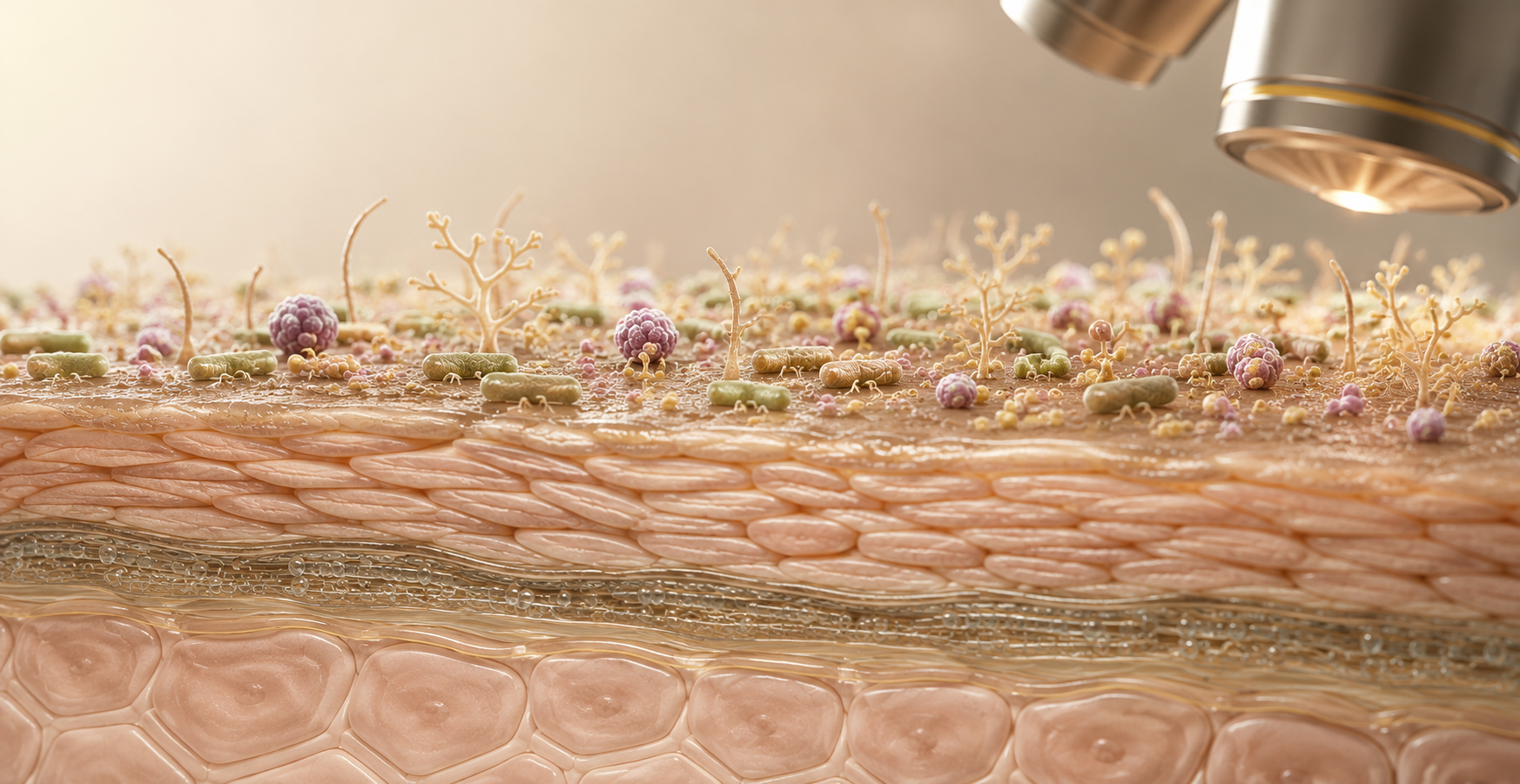
Your skin is home to billions of microscopic organisms that quietly work every day to help keep it healthy. Together, they form the skin microbiome—an invisible ecosystem of beneficial bacteria, fungi and other microorganisms that live alongside your skin cells.
Far from being something to remove, these tiny organisms help defend your skin, support its protective barrier and maintain balance. Understanding the skin microbiome changes the way we think about cleansing, skincare and healthy skin itself.

Full Lesson
Your Skin Is Never Alone
When most people hear the word bacteria, they think of illness or infection.
In reality, many bacteria are not only harmless—they're essential.
Your skin is covered by a vast community of microorganisms, including:
- Beneficial bacteria
- Fungi
- Viruses
- Mites
- Other microscopic life
Collectively, these organisms make up your skin microbiome.
Rather than competing with your skin, they work alongside it. Healthy skin and a healthy microbiome exist in partnership, supporting one another every second of the day.
Scientists now understand that caring for your skin isn't simply about looking after skin cells. It's also about protecting the tiny ecosystem that lives on its surface.
🧠 Did You Know?
The skin microbiome contains billions of microorganisms, with thousands living on every square centimetre of healthy skin. Many of them spend their entire lives helping to protect you.
What Is the Skin Microbiome?
Think of the microbiome as your skin's own natural community.
Just as a healthy garden contains many different plants that keep each other in balance, healthy skin contains many different microorganisms living together.
Each area of the body has its own unique microbiome.
The forehead supports different organisms than the hands.
The scalp has different microorganisms than the legs.
Even the left and right sides of your face may contain slightly different microbial communities.
These microorganisms have adapted to the conditions of each area, including moisture, temperature, oil production and pH.
When this ecosystem is balanced, it helps create an environment where beneficial microbes thrive while less desirable organisms remain under control.

How the Skin Microbiome Protects Your Skin
Your microbiome acts like an invisible neighbourhood watch.
Rather than creating a physical shield, it protects your skin through several different mechanisms.
It Competes for Space
Healthy microorganisms occupy the surface of your skin.
By taking up space and using available nutrients, they make it more difficult for potentially harmful microbes to establish themselves.
It Produces Helpful Substances
Many beneficial bacteria produce natural compounds that discourage the growth of unwanted microorganisms.
These substances help maintain balance without completely eliminating other microbes.
It Communicates With Your Immune System
The microbiome constantly communicates with your skin's immune cells.
This ongoing conversation helps your immune system recognise the difference between harmless organisms and genuine threats.
Scientists believe this communication plays an important role in maintaining healthy, balanced skin.
It Supports the Skin Barrier
Research suggests the microbiome also contributes to a healthy skin barrier.
When the microbiome is balanced, it may help support lipid production, maintain hydration and reinforce the skin's natural defences.
The microbiome, acid mantle and skin barrier are not separate systems—they work together as one integrated protective network.
What Happens When the Microbiome Becomes Unbalanced?
Like any ecosystem, balance matters.
Scientists use the term dysbiosis to describe an imbalance within the microbiome.
Instead of many different beneficial organisms living together, one or two species may begin to dominate while others decline.
This doesn't necessarily cause skin problems on its own, but it may make the skin less resilient.
An unbalanced microbiome has been associated with conditions such as:
- Sensitive skin
- Dry skin
- Eczema
- Acne
- Rosacea
- Increased irritation
It's important to remember that these conditions are complex and involve many factors. The microbiome is only one piece of a much larger picture.
Researchers continue to discover just how influential this invisible ecosystem may be.
❌ Myth vs ✅ Reality
Myth: The cleaner your skin is, the healthier it becomes.
Reality: Healthy skin isn't sterile. Gentle cleansing removes dirt, excess oil and pollutants while allowing beneficial microorganisms to continue supporting your skin.

Supporting a Healthy Skin Microbiome
There is no single product that "creates" a healthy microbiome.
Instead, healthy habits help create the conditions where your natural microbial community can thrive.
These include:
- Cleansing gently rather than aggressively
- Avoiding unnecessary over-exfoliation
- Maintaining a healthy skin barrier
- Using products appropriate for your skin type
- Wearing sunscreen daily to minimise UV-related damage
- Following a consistent skincare routine
Researchers are also exploring ingredients known as prebiotics, probiotics and postbiotics.
These ingredients are designed to support the microbiome in different ways, although this area of skincare continues to evolve as new evidence emerges.
👩⚕️ Skin Therapist Tip
If your skin suddenly becomes more sensitive, resist the urge to add more products.
Instead, simplify your routine for a few weeks using a gentle cleanser, moisturiser and sunscreen. Giving your skin time to rebalance is often more helpful than constantly changing products

Why Scientists Are So Interested in the Microbiome
Only a decade ago, much of the microbiome remained a mystery.
Today, advances in genetic sequencing allow researchers to identify thousands of microorganisms that were previously impossible to study.
Scientists now recognise the microbiome as one of the most important components of healthy skin.
While there is still much to learn, ongoing research suggests the microbiome may influence:
- Skin barrier function
- Hydration
- Inflammation
- Wound healing
- Immune regulation
- Skin ageing
- Sensitivity
This doesn't mean the microbiome is responsible for every skin concern.
Rather, it reminds us that healthy skin depends on many systems working together—not just one ingredient or one product.
✨ Why It Matters
Understanding the skin microbiome changes how we think about skincare.
Healthy skin isn't achieved by removing every microorganism or using stronger products. It's about supporting the natural systems your skin already has.
When your skin barrier, acid mantle and microbiome work together, your skin is often better equipped to stay comfortable, resilient and balanced.
Conclusion
Your skin microbiome is one of the most remarkable parts of your body that you'll never see.
Billions of beneficial microorganisms quietly work alongside your skin every day, helping maintain balance, communicate with your immune system and support your protective barrier.
Rather than fighting against nature, modern skincare increasingly aims to work with it.
By choosing gentle skincare, protecting your skin barrier and avoiding unnecessary disruption, you're also supporting the invisible ecosystem that helps keep your skin healthy.
Key Takeaways
- The skin microbiome is a community of beneficial microorganisms living on your skin.
- Healthy skin depends on a balanced relationship between the microbiome, acid mantle and skin barrier.
- Beneficial microbes help defend the skin and communicate with the immune system.
- Over-cleansing and harsh skincare can temporarily disrupt this balance.
- Gentle, consistent skincare helps support a healthy microbiome.
- Scientists continue to discover new ways the microbiome influences healthy skin.
- Healthy skin is about balance, not sterility.
Continue Your Learning
Now that you've discovered the invisible ecosystem living on your skin, the next lesson explores how your skin naturally changes over time. Go to next lesson

Next Lesson: How Skin Changes With Age — learn how collagen, elastin, cell turnover and the skin barrier gradually evolve throughout life, and what these changes mean for everyday skincare. Go to next lesson