
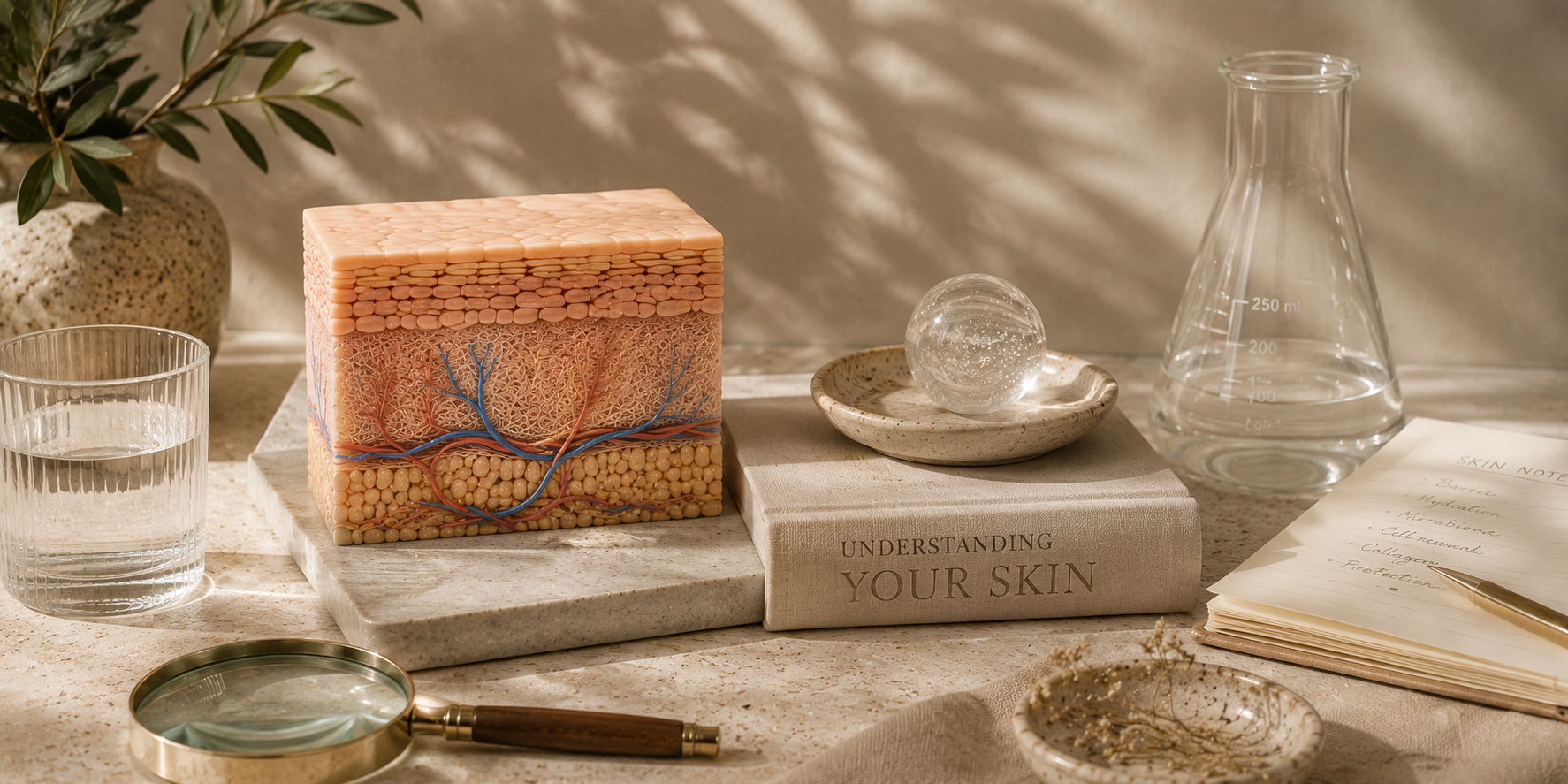
Understanding Your Skin
Your skin is with you every moment of every day. It protects you from the outside world, helps regulate body temperature, supports your immune system and quietly repairs itself while you sleep. Yet despite being the body's largest organ, many of us know surprisingly little about how it actually works.
Understanding your skin is the foundation of good skincare. When you know what your skin is designed to do—and what skincare can realistically support—you can make informed decisions with confidence, rather than following trends or marketing claims.

Your Skin Is More Than Just a Surface
Most people think of skin simply as something we see in the mirror.
In reality, it is one of the body's most remarkable organs.
Covering approximately two square metres in the average adult, your skin performs hundreds of tiny tasks every second. While you're reading this, your skin is:
- Preventing water from escaping your body
- Helping defend against bacteria and viruses
- Producing new skin cells
- Detecting touch, pressure and temperature
- Repairing microscopic damage
- Supporting your body's immune system
Much of this work happens automatically without us ever noticing.
Rather than thinking of skin as a single layer, imagine it as a highly organised living ecosystem. Different cells, oils, proteins, nerves, blood vessels and beneficial microorganisms all work together to keep it functioning as intended.
Healthy skin isn't simply skin that looks good.
Healthy skin is skin that functions well.
💡 Joanne's Insight
After many years treating clients, one lesson stands out above all others: beautiful skin usually begins with understanding rather than products. When people learn how their skin naturally works, they often stop chasing quick fixes and start building routines that genuinely support long-term skin health.
Skin Has Many Important Jobs
Your skin performs far more functions than most people realise.
Protection
Your skin forms a physical barrier between your body and the outside environment.
It helps protect against:
- Pollution
- UV radiation
- Harmful microorganisms
- Physical injury
- Excessive water loss
Without this barrier, even everyday life would become extremely challenging.
Regulation
Your skin helps maintain balance throughout your body.
It regulates:
- Body temperature
- Water balance
- Oil production
- Immune responses
Sweating, blood flow and the tiny openings in your skin all contribute to keeping your internal environment stable.
Sensation
Millions of nerve endings allow your skin to detect:
- Heat
- Cold
- Pressure
- Pain
- Gentle touch
These signals help you interact safely with the world around you.
Repair
Every day, your skin repairs tiny amounts of damage caused by normal living.
This continual maintenance is one reason healthy skin remains resilient throughout life.

Your Skin is Constantly Renewing Itself
One of the most fascinating things about skin is that it is never truly static.
Even when it appears unchanged, millions of tiny processes are happening beneath the surface.
New skin cells are continually produced in the deepest layers of the epidermis. As they mature, they gradually move upwards over several weeks before eventually becoming part of the protective outer layer.
At the same time:
- Older cells naturally shed
- Lipids are produced to strengthen the skin barrier
- Water levels are carefully regulated
- Immune cells remain alert for potential threats
- Structural proteins help maintain firmness and elasticity
This continuous renewal allows skin to adapt to daily life.
However, factors such as age, sun exposure, stress, illness and environmental conditions can influence how efficiently these natural processes occur.
This is one reason healthy skin can look different at various stages of life.
🧠 Did You Know?
Your skin sheds thousands of tiny dead skin cells every hour. Most household dust actually contains a small amount of naturally shed skin cells mixed with fibres and other particles.
Every Part of Skin Has a Different Role
Although we often think of skin as one structure, it is actually made up of several specialised layers that work together.
The outer layer forms the body's protective barrier.
Beneath this lies the supportive framework containing collagen, elastin, blood vessels and nerves.
Deeper still is cushioning tissue that helps insulate and protect the body.
Each layer performs a different job, yet none works independently.
Healthy skin depends on communication between all of these layers.
This is why understanding skin involves much more than simply looking at the surface.
In the next lesson, we'll explore these layers in greater detail.

❌ Myth vs ✅ Reality
Myth: Skin is simply a protective covering.
Reality: Skin is a living organ made up of specialised cells, proteins, blood vessels, immune cells, nerves and beneficial microorganisms that constantly communicate with one another.
Skin Is Different for Everyone
No two people have exactly the same skin.
Many factors influence how skin behaves, including:
- Genetics
- Age
- Hormones
- Climate
- Lifestyle
- Nutrition
- Sleep
- Stress
- Sun exposure
- Skincare habits
These influences explain why one person's skincare routine may not suit someone else.
Rather than searching for the "best" product, it's more helpful to understand what your skin needs.
Good skincare is about supporting your skin's natural functions—not trying to change what makes it unique.
Healthy Skin Doesn't Mean Perfect Skin
One of the biggest misconceptions in skincare is that healthy skin should always look flawless.
In reality, completely normal skin may experience:
- Temporary dryness
- Mild redness after exercise
- Seasonal changes
- Occasional breakouts
- Changes with age
- Variations throughout the menstrual cycle
Healthy skin is resilient.
It adapts, recovers and continues performing its many functions despite everyday challenges.
Understanding this helps create more realistic expectations and healthier skincare habits.
✨ Why It Matters
When you understand what your skin is naturally designed to do, skincare becomes much simpler.
Instead of trying to "fix" every small change, you can focus on supporting the skin's own remarkable ability to protect, renew and maintain itself.
Knowledge often leads to fewer unnecessary products, more consistent routines and better long-term skin health.

What Skincare Can—and Can't—Do
Modern skincare can provide meaningful support for healthy skin.
Products may help:
- Maintain hydration
- Strengthen the skin barrier
- Protect against environmental stress
- Improve the appearance of uneven tone
- Support smoother texture
- Help maintain healthy ageing
However, skincare works alongside your skin's own biology.
It doesn't replace it.
Healthy skin is influenced by many factors beyond skincare alone, including sleep, nutrition, stress management and sun protection.
Understanding these realistic expectations helps you choose products based on evidence rather than promises.
👩⚕️ Skin Therapist Tip
Before buying new products, spend a few minutes simply observing your skin over several days.
Notice how it feels after cleansing, throughout the day and during different seasons. Understanding your skin's natural behaviour is often the first step towards building a routine that genuinely suits you.
Conclusion
Your skin is an extraordinary living organ that quietly protects, renews and supports your body every day.
The more you understand how it functions, the easier it becomes to make informed skincare decisions.
Rather than chasing trends, you'll begin recognising what healthy skin actually looks like, what skincare can realistically achieve, and how small consistent habits can support your skin over time.
Every lesson in the Shanga Academy builds on this foundation, helping you develop confidence through knowledge rather than confusion.
Key Takeaways
- Your skin is the body's largest organ and performs many vital functions.
- Healthy skin is defined by how well it functions, not by looking flawless.
- Skin continually renews itself through complex biological processes.
- Multiple layers work together to protect, support and communicate.
- Everyone's skin is different and changes throughout life.
- Good skincare supports your skin's natural biology rather than replacing it.
- Understanding your skin makes choosing skincare simpler and more confident.
Continue Your Learning
Now that you understand what your skin does, the next lesson explores Skin Layers Explained, where you'll discover how the epidermis, dermis and hypodermis each contribute to healthy, resilient skin—and why every skincare product interacts with these layers differently.